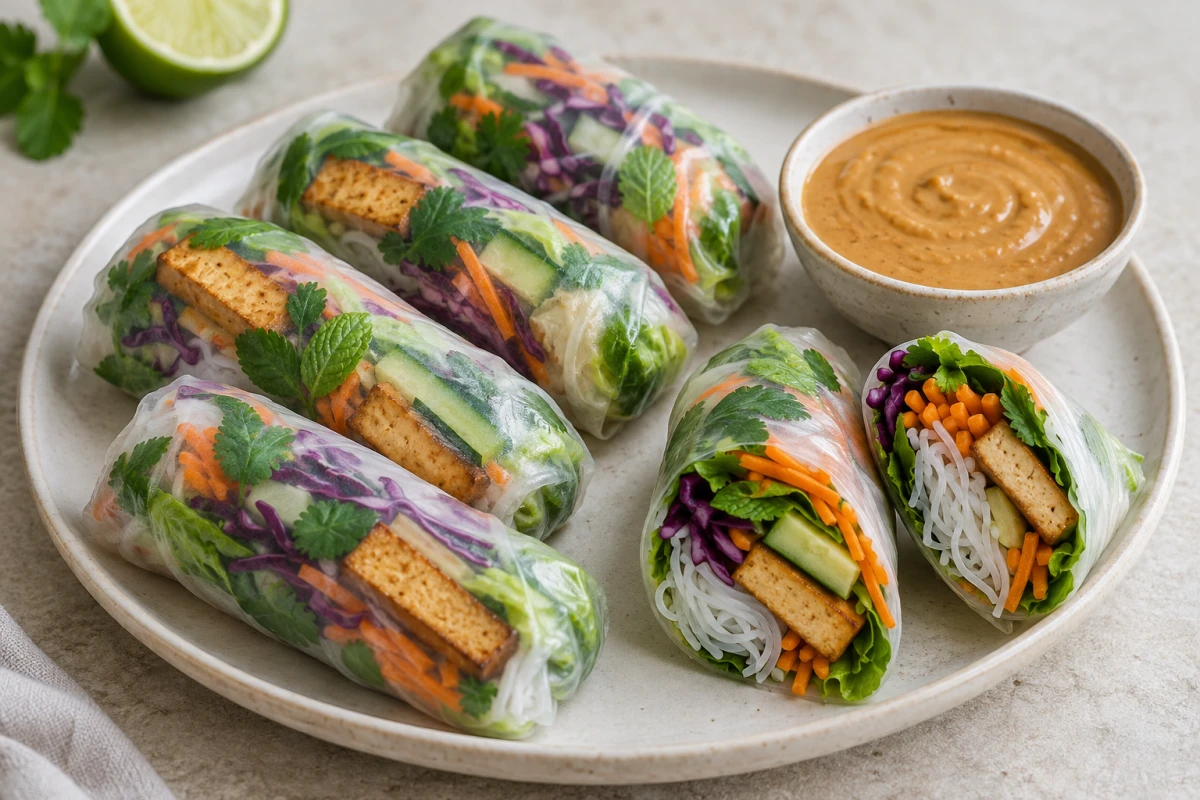
Vietnamese-Inspired Summer Rolls with Tofu and Peanut Dip
Crisp vegetables, rice noodles, and herbs wrapped in rice paper
These Vietnamese-inspired summer rolls combine golden pan-seared tofu, fine rice noodles, crisp vegetables, and plenty of fresh herbs in soft rice paper. A creamy lime-peanut dip turns twelve fresh rolls into a complete vegan meal.
- Prep time
- 35 minutes
- Cook time
- 15 minutes
- Total
- 50 minutes
- Yield
- 12 summer rolls with peanut dip, 3 rolls per main-course serving
Ingredients
- 400 g schnittfester Naturtofu, abgetropft
- 20 ml glutenfreie Tamari-Sojasauce für den Tofu
- 5 ml geröstetes Sesamöl
- 15 ml neutrales Rapsöl zum Braten
- 100 g dünne Reisvermicelli, Trockengewicht
- 12 runde Reispapierblätter, etwa 22 cm Durchmesser
- 120 g knackige Römersalatblätter, harte Rippen entfernt, in 8 cm langen Streifen
- 200 g Salatgurke, entkernt und in 8 cm lange, 3 mm breite Stifte geschnitten
- 150 g Karotten, geschält und in 8 cm lange, 2–3 mm breite Stifte geschnitten
- 120 g Rotkohl, sehr fein gehobelt
- 20 g frische Minzblätter
- 20 g Koriandergrün mit zarten Stielen
- 100 g cremiges Erdnussmus aus 100 % Erdnüssen
- 30 ml glutenfreie Tamari-Sojasauce für den Dip
- 30 ml frisch gepresster Limettensaft
- 15 ml Ahornsirup
- 10 g frischer Ingwer, fein gerieben
- 5 g Knoblauch, fein gerieben
- 60 ml warmes Wasser, bei Bedarf bis zu weitere 15 ml
- 2 g rote Chiliflocken
Instructions
- Press the tofu thoroughly dry with clean paper towels and cut it into twelve equal batons, about 8 × 2 × 1 cm each. Mix 20 ml tamari with the sesame oil in a shallow dish, gently turn the tofu in it, and set aside until frying. Do not leave it at room temperature for more than 20 minutes.
- For the dip, stir the peanut butter, 30 ml tamari, lime juice, maple syrup, ginger, garlic, and chili flakes until smooth. Gradually work in 60 ml warm water. The dip should flow creamily from a spoon; add up to another 15 ml water if the peanut butter is particularly firm. Cover and set aside.
- Cook the rice vermicelli according to the package directions, typically for 3–5 minutes in barely simmering water, until tender but not mushy. Drain immediately, rinse under cold water for 20 seconds, and drain very thoroughly. Snip through the noodles two or three times with kitchen scissors so they divide evenly.
- Heat the rapeseed oil in a large nonstick frying pan over medium-high heat. Lift the tofu batons from the marinade and fry in one layer for 6–8 minutes, turning to brown three or four sides. Add the marinade remaining in the dish during the final minute and let it reduce completely. Transfer the tofu to a clean plate.
- Arrange the lettuce, cucumber, carrot, red cabbage, mint, and cilantro in separate piles. Divide the noodles into twelve portions of approximately 25 g cooked weight each. Prepare a wide shallow plate or bowl of lukewarm water and place a clean, lightly dampened board beside it.
- Dip only one rice paper sheet at a time in the water for 5–8 seconds; it should still feel distinctly firm. Place it on the damp board and wait 20–30 seconds until pliable. On the lower third, arrange about 10 g lettuce, one noodle portion, one twelfth each of the cucumber, carrot, and cabbage, plus a few herbs. Place one tofu baton in front. Leave at least a 3 cm border all around.
- Fold the bottom edge snugly over the filling, fold both sides inward, and roll firmly upward without pulling. The paper should fit smoothly without tearing. Place seam-side down on a lightly dampened platter. Repeat one at a time with the remaining eleven sheets; do not let finished rolls touch.
- Divide three rolls among each of four plates and allot one quarter of the total peanut dip to each plate. Serve immediately. The full amount of dip is included in the stated recipe; additional sauces or sides are excluded from the nutrition values.
Tips
- Prepare every filling before dipping the first wrapper; softened rice paper will not wait and otherwise sticks to the board.
- Wet rice paper only briefly. It continues softening on the damp board and tears more easily when soaked too long.
- Cut the vegetables uniformly thin and about 8 cm long so the rolls stay compact and no sharp ends pierce the wrapper.
- Rinse the noodles cold and drain them thoroughly; warm or wet noodles make the wrapper sticky and soft.
- Keep the rolls apart and serve immediately because touching rice paper sticks together and can become leathery over time.
Common mistakes
- Reispapier bis zur vollständigen Weichheit einweichen → nach 5–8 Sekunden noch fest herausnehmen und auf dem Brett weich werden lassen.
- Zu viel Füllung verwenden → die genannten Zwölftel-Portionen und mindestens 3 cm freien Rand einhalten.
- Füllung nass oder warm einrollen → Nudeln vollständig kalt und trocken, Tofu nur noch warm bis zimmerwarm verwenden.
- Rollen beim Aufwickeln ziehen → straff falten, aber das empfindliche Papier nicht dehnen.
- Fertige Rollen stapeln oder aneinanderlegen → in einer Lage mit Abstand lagern, sonst kleben sie untrennbar zusammen.
- Tofu in einer überfüllten Pfanne dämpfen → große Pfanne und eine Lage verwenden, bis mehrere Seiten goldbraun sind.
Variations and substitutions
- Naturtofu: durch 400 g vorgepressten extra festen Tofu ersetzen; trotzdem trocken tupfen. Seidentofu ist nicht geeignet.
- Rotkohl: durch 120 g sehr fein geschnittenen Weißkohl ersetzen.
- Koriander: durch weitere 20 g Minze plus 15 g Thai-Basilikum ersetzen; das Aroma verändert sich.
- Erdnussfrei: Erdnussmus durch 100 g ungesüßtes Sonnenblumenkernmus ersetzen; Rezeptname, Bild, Allergene und Nährwerte müssen dann angepasst werden.
- Mild: Chiliflocken ersatzlos weglassen.
- Glutenfrei nur mit ausdrücklich glutenfrei gekennzeichneter Tamari, Reisnudeln und Reispapier; gewöhnliche Sojasauce ist kein geeigneter Ersatz.
- Sesamfrei: Sesamöl durch 5 ml neutrales Rapsöl ersetzen; das geröstete Aroma entfällt und das Allergenprofil ändert sich.
Storage and notes
Storage
Sommerrollen am besten direkt verzehren. Für höchstens 6 Stunden jede Rolle einzeln in ein sauberes, leicht feuchtes, nicht tropfnasses Tuch wickeln, in einer Lage luftdicht verpacken und bei höchstens 5 °C kühlen. Erdnussdip separat luftdicht bis zu 3 Tage kühlen und vor dem Servieren mit wenig Wasser glatt rühren. Gegarten Tofu und Nudeln vor dem Rollen zügig verarbeiten, nicht länger als 2 Stunden ungekühlt lassen. Zusammengesetzte Rollen und Dip nicht einfrieren; Papier, Gemüse und Kräuter verlieren ihre Textur. Angebissene oder bereits eingedippte Reste entsorgen und nicht zurücklagern.
Allergens
Enthält Erdnüsse, Soja und Sesam. Gewöhnliche Sojasauce enthält meist Weizen/Gluten; für die ausgewiesene glutenfreie Möglichkeit ausschließlich zertifizierte glutenfreie Tamari und kontrollierte Reisprodukte verwenden. Sonnenblumenkernmus verändert das Allergenprofil, benötigt aber ebenfalls eine Produktprüfung.
Editorial context
This presentation and its supporting notes were edited for Rezepte daheim. It does not claim invention of the dish.
No personal kitchen test is currently documented for this version.