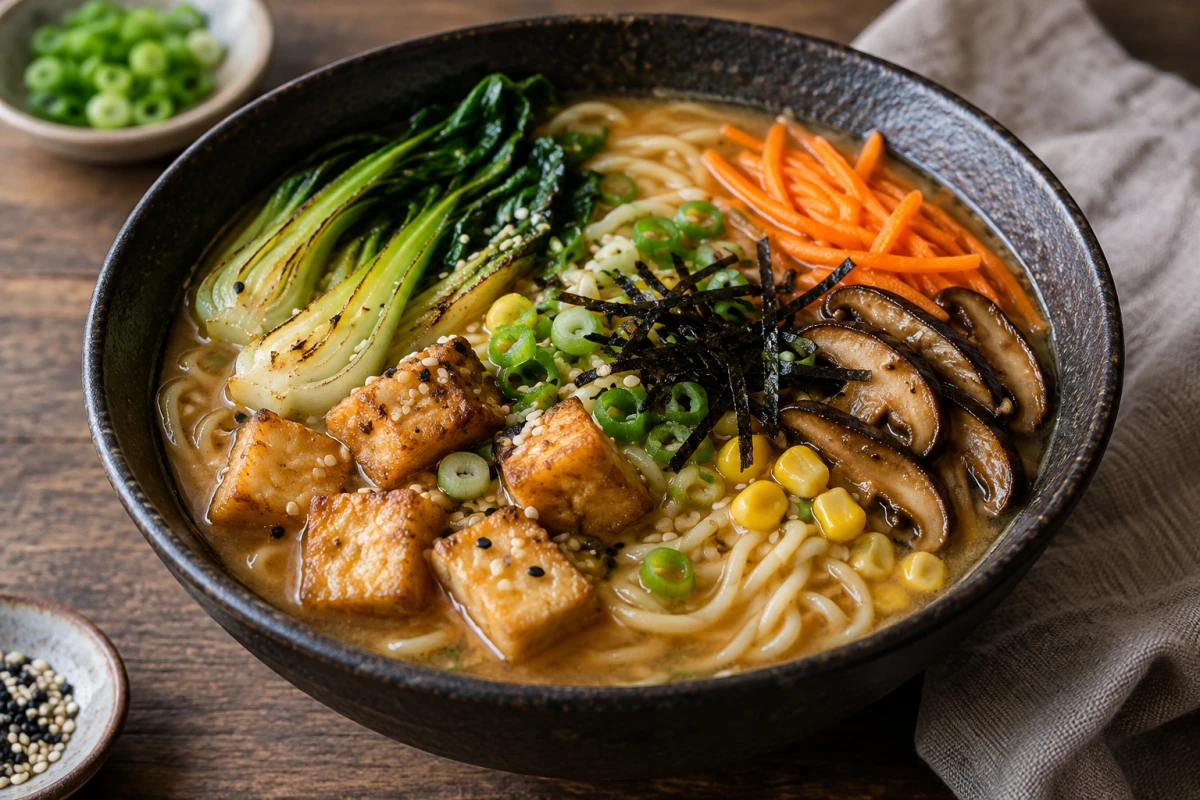
Vegan Miso Ramen with Tofu and Pak Choi
Umami-rich broth, crisp tofu, and plenty of vegetables
Golden tofu, ramen noodles, shiitake, and pak choi meet a savory broth seasoned with white miso, soy sauce, ginger, and sesame. Cooking the noodles separately and adding the miso off the heat keeps the broth and toppings distinct, aromatic, and balanced.
- Prep time
- 20 minutes
- Cook time
- 30 minutes
- Total
- 50 minutes
- Yield
- 4 large bowls of miso ramen, 4 main-course servings
Ingredients
- 300 g fester Naturtofu, abgetropft
- 300 g getrocknete vegane Weizen-Ramen-Nudeln ohne Ei
- 1,5 l natriumarme vegane Gemüsebrühe
- 80 g helle Misopaste
- 30 ml Sojasauce, geteilt
- 15 ml Reisessig
- 10 ml geröstetes Sesamöl
- 20 ml Rapsöl
- 200 g frische Shiitakepilze, Stiele entfernt
- 300 g kleiner Pak Choi
- 120 g Karotten, geschält
- 150 g Gemüsemais, abgetropft
- 20 g frischer Ingwer, fein gerieben
- 12 g Knoblauch, fein gerieben
- 4 Frühlingszwiebeln
- 2 Nori-Blätter (zusammen ca. 5 g)
- 10 g Sesamsamen
Instructions
- Wrap the tofu in a clean kitchen towel, place it between two boards, and weigh it down with an approximately 1 kg pot for 10 minutes. Meanwhile, slice the shiitake 5 mm thick, halve the pak choi lengthwise, and separate the thick stems from the leaves. Cut the carrots into fine matchsticks, the spring onions into rings, and the nori into narrow strips. Drain the corn thoroughly.
- Cut the tofu into approximately 2 cm cubes and gently toss with 10 ml soy sauce. Heat the rapeseed oil in a wide, heavy soup pot over medium-high heat. Fry the tofu in a single layer for 7–8 minutes until golden on all sides, turning only when it releases easily. Transfer to a clean plate.
- Cook the shiitake in the remaining oil for 4–5 minutes, until released moisture has evaporated and the edges brown. Add the ginger and garlic and cook for 30 seconds while stirring until fragrant.
- Pour in the vegetable stock and remaining 20 ml soy sauce, scrape up the browned bits, and bring to a boil. Add the carrots and pak choi stems and simmer gently uncovered for 5 minutes.
- As soon as the broth comes to a boil, bring plenty of unsalted water to a boil in a second pot. Cook the ramen noodles according to the package directions, typically 3–4 minutes, until just tender with a slight bite. Drain in a sieve, briefly rinse with warm water, and drain thoroughly. Do not cook them in the broth.
- Add the pak choi leaves and corn to the broth and cook gently for 2 minutes, until the leaves wilt while the stems retain some bite. Remove the pot completely from the heat.
- Ladle about 250 ml hot but no longer boiling broth into a bowl and whisk in the miso until smooth. Stir the miso mixture, rice vinegar, and sesame oil back into the pot. Do not boil afterward. Taste; because miso and soy sauce vary in salinity, adjust only if needed without adding unlisted salt.
- Divide the noodles evenly among four large preheated bowls. Ladle over the hot broth, shiitake, carrots, pak choi, and corn. Arrange the fried tofu on top and finish with spring onions, nori, and sesame seeds. Serve immediately; egg, meat, and other unlisted toppings are not part of the recipe.
Tips
- Press the tofu while preparing the other ingredients and turn it only when it releases from the pot; this helps it brown instead of breaking apart.
- Cook the ramen separately and drain thoroughly. Noodle starch would make the broth unnecessarily thick and cloudy.
- Add the pak choi stems and leaves at different times so both finish with the correct texture.
- First smooth the miso with broth and stir it in only off the heat; vigorous boiling dulls its delicate aroma.
- Preheat the bowls and assemble immediately because ramen noodles continue to swell quickly in hot broth.
Common mistakes
- Nassen Tofu dicht im Topf braten → 10 Minuten pressen, in einer Lage braten und erst nach dem Lösen wenden.
- Pilze nur weich dünsten → Flüssigkeit vollständig verdampfen lassen und die Ränder sichtbar bräunen.
- Nudeln direkt in der Brühe garen → separat kochen, warm abspülen und gründlich abtropfen lassen.
- Pak Choi vollständig gleichzeitig zugeben → Stiele 5 Minuten, Blätter erst in den letzten 2 Minuten garen.
- Misopaste in sprudelnde Brühe geben → Topf vom Herd ziehen, Miso separat glattrühren und danach nicht mehr kochen.
- Fertig angerichtete Ramen stehen lassen → sofort servieren, sonst werden Nudeln weich und saugen Brühe auf.
Variations and substitutions
- Shiitake: durch 200 g braune Champignons ersetzen und ebenfalls kräftig bräunen; das Aroma wird milder.
- Pak Choi: durch 200 g frischen Blattspinat ersetzen. Keine Stielphase durchführen; Spinat erst in den letzten 60 Sekunden zusammenfallen lassen.
- Glutenfrei: Weizen-Ramen durch 300 g ausdrücklich glutenfreie Reis-Ramen ersetzen und zertifiziert glutenfreie Tamari, Misopaste und Gemüsebrühe verwenden. Garzeit der Nudeln nach Packungsangabe anpassen; Soja und Sesam bleiben Allergene.
- Mais: durch 150 g geschälte Edamame ersetzen und 3 Minuten in der Brühe erhitzen; dadurch steigt der Sojaanteil und die Nährwerte ändern sich.
- Nori kann ersatzlos entfallen; keine fischhaltige Algenmischung als Ersatz verwenden, wenn das Gericht vegan bleiben soll.
Storage and notes
Storage
Ramen höchstens 2 Stunden bei Raumtemperatur stehen lassen. Brühe mit Gemüse und Tofu, Nudeln sowie trockene Garnituren getrennt in flachen Behältern zügig abkühlen und luftdicht bei höchstens 5 °C lagern. Brühe und Tofu innerhalb von 2 Tagen verbrauchen, Nudeln möglichst am nächsten Tag. Brühe mit Tofu nur einmal auf mindestens 74 °C erhitzen; anschließend vom Herd ziehen und erst dann mit Nudeln und Garnituren anrichten. Bereits zusammengesetzte Schalen werden weich und sind nicht zum Lagern empfohlen. Wegen Qualitätsverlust von Tofu, Pak Choi und Nudeln nicht einfrieren. Produktvorgaben für Tofu und Brühe haben Vorrang.
Allergens
Enthält Soja, Weizen/Gluten und Sesam. Misopaste und Sojasauce enthalten Soja und können Weizen enthalten; Weizen-Ramen enthalten Gluten. Gemüsebrühe kann Sellerie, Gluten oder weitere deklarationspflichtige Allergene enthalten. Sämtliche Produkte müssen ausdrücklich vegan sein; Etiketten einzeln prüfen. Schalenfrüchte und Milch sind nicht Bestandteil des Grundrezepts, Kreuzkontamination bleibt produktabhängig.
Editorial context
This presentation and its supporting notes were edited for Rezepte daheim. It does not claim invention of the dish.
No personal kitchen test is currently documented for this version.