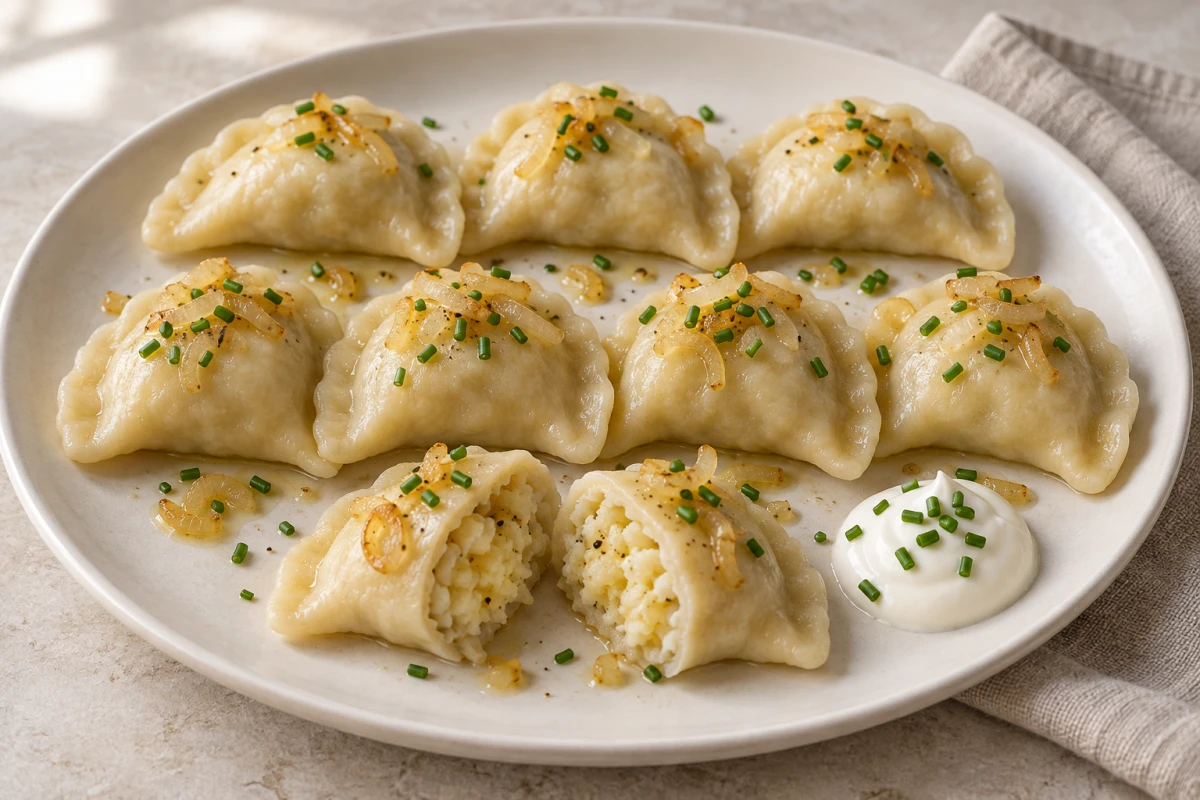
Polish Pierogi with Potato and Twaróg Filling
Tender egg-free dough, creamy filling, and golden buttered onions
These Polish-inspired pierogi combine a supple egg-free hot-water dough with a savoury filling of floury potatoes, twaróg, buttered onions, and black pepper. One shared resting and cooling period keeps the dough elastic and the filling dry enough to seal securely. The recipe makes exactly 32 boiled dumplings for four main-course servings.
- Prep time
- 1 hr 15 min
- Cook time
- 45 minutes
- Rest time
- 30 minutes
- Total
- 2 hr 30 min
- Yield
- 32 medium pierogi (4 main-course servings of 8)
Ingredients
- 350 g German Type 550 wheat flour or bread flour
- 20 g German Type 550 wheat flour or bread flour for rolling
- 180 ml water, heated to 70–75°C
- 20 ml rapeseed oil
- 5 g fine salt
- 500 g floury potatoes, weighed after peeling and cut into 3 cm pieces
- 250 g semi-fat twaróg or Polish farmer's cheese, well drained and finely crumbled
- 180 g yellow onions, cut into 5 mm dice
- 20 g unsalted butter
- 5 g fine salt
- 1.5 g freshly ground black pepper
- 100 g yellow onions, cut into 3 mm half-rings
- 20 g unsalted butter
- 120 g soured cream, about 20% fat
- 15 g fresh chives, finely sliced
- 3 litres water
- 20 g fine salt
Instructions
- Prepare the potatoes, both onion portions, and chives as specified. Drain the twaróg thoroughly in a sieve and crumble finely. Set out a tray or large shallow plate for the filling plus a board covered with a clean cloth for the shaped pierogi.
- Put the potato pieces in a pan, cover with cold water, bring to the boil, and simmer gently for 15–18 minutes until they slide off a knife without resistance when pierced. At the same time, melt 20 g butter in a frying pan over medium heat, cook the 180 g diced onions for 8–10 minutes until soft and pale golden, and remove. Add the other 20 g butter and the 100 g onion half-rings to the same pan and cook for 7–9 minutes until golden; reserve for the garnish.
- Drain the potatoes extremely well, return them to the hot pan, and let them steam dry over the switched-off hob for 2 minutes. Pass through a potato ricer or mash finely; do not blend. Briefly but thoroughly mix in the twaróg, the 180 g portion of cooked diced onions with their butter, 5 g salt, and the pepper. Spread the filling no more than 1.5 cm thick on the tray.
- For the dough, combine the 350 g flour and 5 g salt. Pour in the 70–75°C water and rapeseed oil, stir for 1 minute with a sturdy spoon, and handle only once the mixture is safe to touch. Knead by hand for 7–8 minutes until smooth, soft, and elastic; do not knead in extra flour.
- Shape the dough into a ball, cover directly against its surface, and rest at room temperature for exactly 30 minutes. During the same 30 minutes, the thinly spread filling cools completely to room temperature. Continue only with cool, firm filling; if the centre remains warm or damp, extend the cooling period and total time accordingly.
- Divide the dough into four equal-weight pieces and expose only one at a time. Roll the first piece evenly to 1.5 mm on a little of the 20 g rolling flour. Cut eight circles with a 9 cm cutter and re-roll scraps once. Repeat with the other three pieces to make exactly 32 circles.
- Place about 28 g cold filling in the centre of each circle, leaving an 8–10 mm border. Fold into a half-moon, press air outward from the filling, and seal first with fingertips, then firmly a second time. Keep filling and flour out of the seam. Store the shaped pierogi in a single layer beneath the cloth.
- Only after shaping, bring the 3 litres water and 20 g salt to a full boil in a pot of at least 5 litres. Reduce the heat to a steady gentle boil. Cook the pierogi in four batches of eight, carefully releasing them from the base once immediately after adding.
- Once an entire batch has floated, simmer gently for another 2½ minutes. Open one pierogi from the first batch: the dough must be opaque throughout with no raw flour line and the filling steaming hot; a thermometer should register at least 74°C in the centre. Lift out with a slotted spoon, drain well, and lay in one layer. Cook every later batch in the same way, adjusting by 30–60 seconds if required.
- Divide eight pierogi onto each of four warmed plates. Briefly reheat the buttered onions, distribute all of them evenly over the servings, and add 30 g soured cream alongside each. Scatter with all the chives and serve immediately; additional sides and drinks are excluded from the nutrition calculation.
Tips
- Water at 70–75°C binds some of the flour starch and makes the egg-free dough supple. Begin with a spoon and check that the mixture is safe to touch before kneading.
- Rice or hand-mash the potatoes; never use a blender or stick blender. Excessive shear releases starch and makes the filling gluey.
- Keep unused dough pieces and cut circles covered at all times. Thin edges dry quickly and then seal poorly even under firm pressure.
- Portion about 28 g filling for each of all 32 pieces. A consistent amount prevents both empty doughy edges and overfilled seams and gives the same cooking point.
- Boil pierogi only gently and release them once immediately after adding. A violent boil or constant stirring stresses the seams and makes the dumplings burst.
Common mistakes
- Using wet potatoes or warm filling → steam-dry the potatoes for 2 minutes and cool the thinly spread filling completely during the dough rest.
- Kneading extra flour into dough that initially feels tacky → knead for the full 7–8 minutes and use only the specified 20 g for rolling.
- Rolling thicker than 1.5 mm → check the thickness; overly thick dough stays heavy at the seams and takes longer to cook.
- Trapping air, filling, or loose flour in the seam → keep the border clean, press air outward, and seal firmly twice.
- Boiling too many pierogi in violently bubbling water → cook exactly four batches of eight at a steady gentle boil and release from the base only once.
Variations and substitutions
- Twaróg substitute: use 250 g well-drained curd cheese or farmer's cheese 1:1. For cottage cheese, drain 300 g in the refrigerator for at least 8 hours and use 250 g of the drained cheese; this extra time is excluded from the stated 150 minutes.
- German Type 405 or lower-protein plain flour: substitute 1:1, but begin with only 170 ml hot water and add the remaining 10 ml only if the dough is not soft and elastic after 4 minutes of kneading.
- Vegan: replace the twaróg with 250 g firm plain tofu pressed for 20 minutes and finely crumbled, plus 10 ml lemon juice and 15 g nutritional yeast; replace butter and soured cream 1:1 with vegan equivalents. Soy becomes an allergen, labels must be checked for gluten and nuts, and nutrition changes.
- Yoghurt instead of soured cream: use 120 g Greek yoghurt with 5% fat; milk remains an allergen, the accompaniment becomes lighter, and nutrition changes.
- Pan-fried: allow the boiled pierogi to steam dry fully for 10 minutes, then fry in 20 ml rapeseed oil over medium heat for 3–4 minutes per side until golden. Allow 20 additional minutes in total; nutrition changes.
Storage and notes
Storage
Do not leave cooked pierogi, buttered onions, or soured cream unrefrigerated for more than 2 hours; then refrigerate them separately in airtight containers at no more than 5°C. Keep pierogi and buttered onions for up to 2 days and follow the package storage instructions for soured cream. Reheat pierogi only once in a little water or in a frying pan until they reach at least 74°C throughout, serve with freshly reheated onions, and discard reheated leftovers. Uncooked shaped pierogi may be frozen in one layer for 2 hours, then packed airtight for up to 2 months; cook directly from frozen in gently boiling salted water for 3½–4 minutes after all have floated. Do not freeze the soured cream with them.
Allergens
Contains wheat/gluten and milk. The base dough contains no egg, but flour, twaróg, butter, and soured cream may carry product-specific precautionary statements for egg, nuts, soy, or other allergens. Egg-free and nut-free claims apply only with suitably labelled ingredients and controlled avoidance of cross-contact. The vegan tofu variation contains soy; nutritional yeast and vegan substitutes must additionally be checked for gluten, nuts, and other allergens.
Food safety
- Raw flour can carry harmful germs: do not taste the dough, minimise airborne flour dust, and clean hands, bowls, equipment, and work surfaces after contact.
- Initially mix the 70–75°C water with a sturdy spoon and knead only when the dough is safe to touch. Keep clear of steam and splashes during boiling.
- Keep twaróg and soured cream at no more than 5°C until needed. Do not leave the filling unrefrigerated for more than 2 hours and use it for shaping only once fully cooled.
- Cook the pierogi gently until the dough is opaque and the filling steaming hot; verify at least 74°C in the centre of the first one. Chill cooked leftovers within 2 hours and reach 74°C again during the single reheating.
Editorial context
This presentation and its supporting notes were edited for Rezepte daheim. It does not claim invention of the dish.
No personal kitchen test is currently documented for this version.