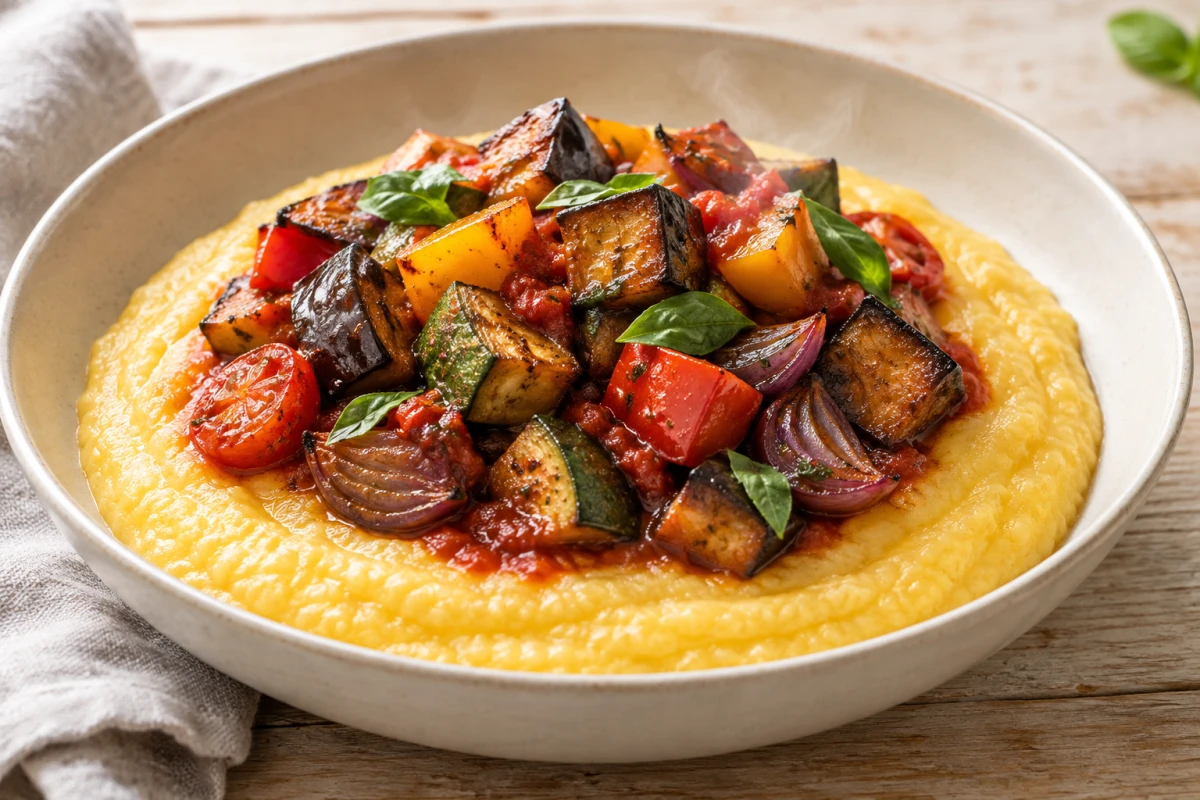
Oven-Roasted Ratatouille with Creamy Polenta
Mediterranean roasted vegetables over silky cornmeal
Eggplant, zucchini, peppers, tomatoes, and red onion roast at high heat into a concentrated, herb-scented ratatouille while creamy polenta cooks in parallel on the stove. This vegan main course combines browned vegetable edges with a soft, satisfying base and contains no cheese.
- Prep time
- 30 minutes
- Cook time
- 50 minutes
- Total
- 1 hr 20 min
- Yield
- 4 main-course bowls of oven-roasted ratatouille with creamy polenta
Ingredients
- 450 g Aubergine, in 2,5 cm große Würfel geschnitten
- 350 g Zucchini, in 2,5 cm große Stücke geschnitten
- 250 g rote Paprika, entkernt und in 2,5 cm große Stücke geschnitten
- 250 g gelbe Paprika, entkernt und in 2,5 cm große Stücke geschnitten
- 200 g rote Zwiebeln, in 2 cm breite Spalten geschnitten
- 300 g Kirschtomaten, halbiert
- 20 g Knoblauch, in dünne Scheiben geschnitten
- 45 ml natives Olivenöl extra
- 8 g feines Salz, geteilt
- 2 g schwarzer Pfeffer, frisch gemahlen
- 3 g getrockneter Thymian
- 1 g getrockneter Rosmarin, fein zerdrückt
- 400 g stückige Tomaten aus der Dose
- 15 ml milder Rotweinessig
- 15 g frisches Basilikum, grob gezupft
- 200 g grober Maisgrieß für Polenta, Garzeit etwa 20–25 Minuten
- 900 ml Wasser
- 6 g feines Salz für die Polenta
- 30 ml natives Olivenöl extra für die Polenta
- 1 g schwarzer Pfeffer, frisch gemahlen
Instructions
- Preheat the oven to 220°C conventional or 200°C fan. Line two large metal baking sheets with parchment. Prepare the eggplant, zucchini, both peppers, onions, and cherry tomatoes, keeping the specified sizes so everything cooks evenly.
- In a very large bowl, thoroughly toss the eggplant, zucchini, peppers, and onions with 35 ml olive oil, 6 g salt, 2 g pepper, thyme, and rosemary. Divide between both trays so the pieces sit mostly in one layer with little contact.
- Roast the vegetables for 20 minutes. Remove both trays, turn the vegetables with a spatula, and swap the tray positions. Toss the cherry tomatoes and garlic with the remaining 10 ml olive oil and distribute evenly across the trays.
- Roast for another 15 minutes. Divide the canned tomatoes between both trays and gently fold them through. Roast for another 10–15 minutes, until the eggplant is completely tender, the peppers and zucchini are browned at the edges, and the tomato liquid is substantially reduced. Total oven time is 45–50 minutes.
- When the vegetables have about 25 minutes left after turning, bring 900 ml water and 6 g salt to a boil in a heavy saucepan for the polenta. Pour in the polenta in a thin stream while whisking vigorously to prevent lumps.
- Immediately reduce the heat to low. Cook the polenta uncovered at a very gentle simmer for 20–25 minutes, stirring frequently at first and then scraping the bottom and corners with a wooden spoon at least every 2 minutes. It is ready when the grains are tender, the mixture flows creamily, and it briefly pulls away from the base as you stir.
- Remove the polenta from the heat and vigorously stir in 30 ml olive oil and 1 g pepper. If too thick, add hot water one tablespoon at a time; it should fall slowly from the spoon rather than set firm. Cover and hold for no longer than 5 minutes.
- Combine the roasted vegetables on one tray. Fold in the red wine vinegar, remaining 2 g salt, and basil. Taste; the ratatouille should be juicy and spoonable but leave no thin liquid pooling on the tray.
- Divide both the polenta and ratatouille into four equal portions. Spread one quarter of the polenta in each bowl and top with one quarter of the ratatouille. Serve immediately; cheese, bread, and any other unlisted sides are not part of the recipe or nutrition values.
Tips
- Use two large trays and spread the vegetables in one layer; crowded pieces steam and remain pale.
- Add the cherry tomatoes and garlic only after 20 minutes so they roast down without burning.
- Fold in the canned tomatoes only during the final roasting stage; this preserves browned edges while the sauce reduces.
- Whisk the polenta into boiling water in a thin stream and regularly scrape the corners of the pan to prevent lumps and sticking.
- Adjust the polenta with hot water immediately before serving; it thickens quickly as it stands and should still flow creamily.
Common mistakes
- Gesamtes Gemüse auf ein kleines Blech häufen → auf zwei großen Blechen in möglichst einer Lage rösten.
- Aubergine und Zucchini sehr unterschiedlich schneiden → einheitliche 2,5-cm-Stücke herstellen, damit beide gleichzeitig weich werden.
- Knoblauch von Beginn an rösten → erst nach 20 Minuten zufügen, sonst wird er dunkel und bitter.
- Ratatouille mit dünner Tomatenflüssigkeit servieren → nach Zugabe der Dosentomaten weiter rösten, bis keine wässrige Pfütze bleibt.
- Polenta auf hoher Hitze unbeaufsichtigt kochen → niedrige Hitze verwenden und Boden sowie Ecken regelmäßig ausstreichen.
- Polenta lange abgedeckt stehen lassen → höchstens 5 Minuten halten und vor dem Servieren mit heißem Wasser cremig rühren.
Variations and substitutions
- Gelbe Paprika: durch weitere 250 g rote Paprika ersetzen; grüne Paprika ist herber und kein geschmacklich neutraler Ersatz.
- Kirschtomaten: durch 300 g feste Roma-Tomaten in 2,5 cm großen Stücken ersetzen.
- Frisches Basilikum: durch 15 g glatte Petersilie ersetzen; das Aroma wird weniger typisch mediterran.
- Grobe Polenta: durch 200 g Instant-Polenta ersetzen und nach Packungsangabe typischerweise 3–5 Minuten garen; erst 750 ml Wasser verwenden und bei Bedarf ergänzen.
- Rotweinessig: durch 15 ml frisch gepressten Zitronensaft ersetzen und erst nach dem Rösten einrühren.
- Glutenfrei nur mit ausdrücklich glutenfrei gekennzeichnetem Maisgrieß und kontaminationsfrei verarbeiteten Gewürzen ausweisen.
- Käse ist keine notwendige Zutat. Wer Parmesan ergänzt, verändert VeganDiet, Allergene, Bild und Nährwerte und muss diese Angaben anpassen.
Storage and notes
Storage
Ratatouille und Polenta spätestens innerhalb von 2 Stunden getrennt in flache Behälter füllen, auf höchstens 5 °C herunterkühlen und luftdicht bis zu 3 Tage lagern. Nur einmal wiedererwärmen und beide Komponenten vollständig auf mindestens 74 °C erhitzen. Polenta dabei pro Portion mit 30–45 ml Wasser bei niedriger Hitze cremig rühren; Ratatouille abgedeckt erhitzen und danach bei Bedarf kurz offen reduzieren. Ratatouille ist bis zu 3 Monate einfrierbar, wird nach dem Auftauen jedoch weicher. Polenta bis zu 2 Monate einfrierbar, kann aber körniger werden. Über Nacht im Kühlschrank auftauen; bereits aufgewärmte Reste entsorgen.
Allergens
Die aufgeführten Grundzutaten enthalten keines der 14 in der EU kennzeichnungspflichtigen Hauptallergene. Maisgrieß, Dosentomaten, Essig und Gewürze können produktionsbedingt Spuren oder Zusätze enthalten; Etiketten prüfen. Für eine glutenfreie Ausweisung ausschließlich zertifizierten Maisgrieß und kontrollierte Gewürze verwenden. Parmesan oder andere optionale Käsezugaben würden Milch als Allergen ergänzen und sind nicht Teil dieses Rezepts.
Editorial context
This presentation and its supporting notes were edited for Rezepte daheim. It does not claim invention of the dish.
No personal kitchen test is currently documented for this version.