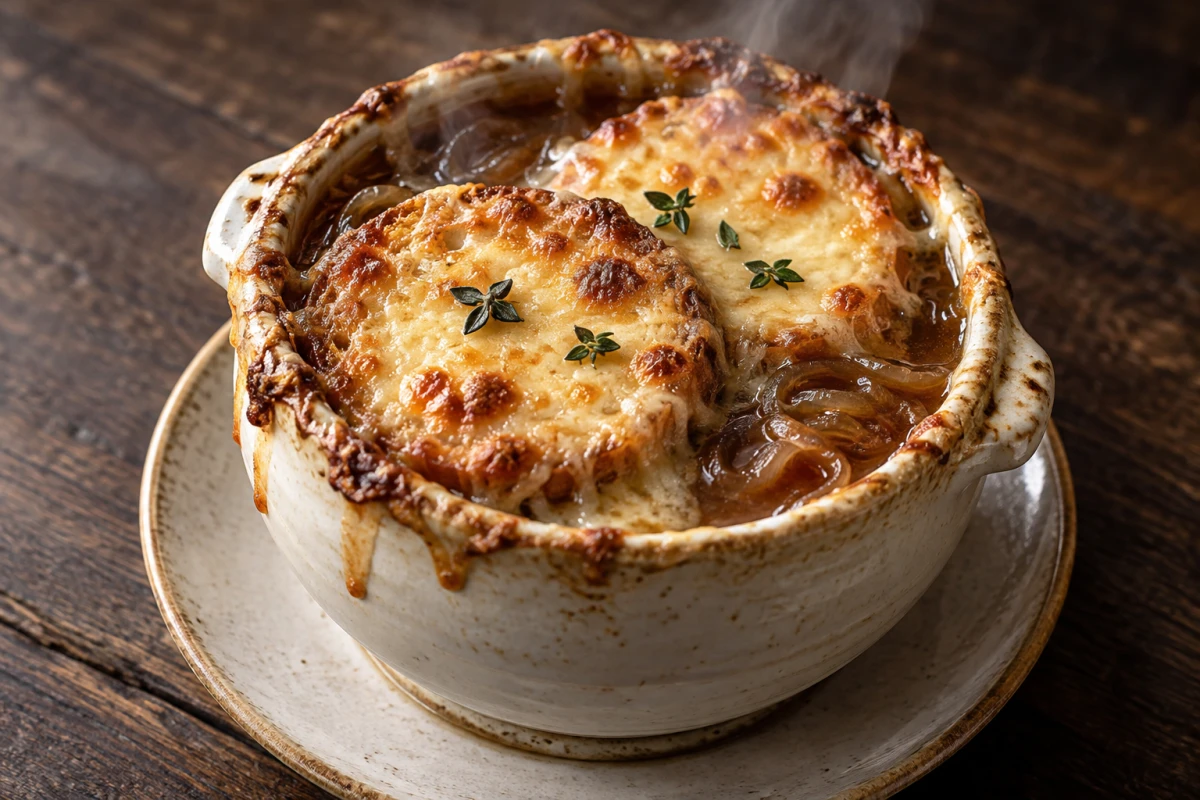
French Onion Soup with Gruyère
Deeply caramelized onions beneath a crisp cheese crust
This French-inspired onion soup builds its deep flavor without added sugar, using slowly caramelized onions, dry white wine, beef stock, and thyme. Toasted baguette and Gruyère are browned directly over four ovenproof soup bowls, turning the soup into a complete and warming main course.
- Prep time
- 20 minutes
- Cook time
- 1 hr 15 min
- Total
- 1 hr 35 min
- Yield
- 4 ovenproof soup bowls with 2 cheese toasts each, approximately 2 kg total
Ingredients
- 1,2 kg gelbe Zwiebeln, geschält gewogen und in gleichmäßigen 3 mm dünnen Halbringen
- 40 g ungesalzene Butter
- 15 ml natives Olivenöl
- 6 g feines Salz
- 12 g Knoblauch, fein gehackt
- 15 g Weizenmehl Type 405
- 200 ml trockener Weißwein
- 1,2 l natriumarmer Rinderfond
- 2 getrocknete Lorbeerblätter
- 8 g frische Thymianblätter, geteilt in 6 g für die Suppe und 2 g zum Anrichten
- 1 g schwarzer Pfeffer, frisch gemahlen
- 200 g Baguette, in exakt 8 Scheiben zu je etwa 25 g
- 200 g Gruyère, grob gerieben und in 8 Portionen zu je 25 g geteilt
Instructions
- Slice the onions evenly into 3 mm half-moons, chop the garlic, strip the thyme leaves, cut the baguette into exactly eight slices, and divide the Gruyère into eight 25 g portions. Set out four ovenproof soup bowls with a capacity of at least 550 ml. Together, these tasks make up the 20-minute prepTime.
- Melt the butter and olive oil in a wide, heavy pot about 28 cm across over medium heat. Add the onions and 6 g salt, mix thoroughly, cover, and soften for 10 minutes. Stir once after 5 minutes; the onions should release liquid without browning yet.
- Remove the lid and caramelize the onions uncovered over medium-low heat for exactly 35 more minutes. Stir across the base every 5 minutes at first, then every 1–2 minutes during the final 15 minutes. They are ready when deep golden brown, reduced visibly to about one third of their original volume, and soft and jammy, without black or bitter spots.
- Add the garlic and stir for 30 seconds. Sprinkle the flour evenly over the onions and cook for another 90 seconds while stirring, until no dry flour remains visible. Keep the flour pale and do not let it scorch on the pot base.
- Deglaze with the white wine and scrape up all browned residue with a wooden spoon. Reduce briskly for exactly 5 minutes, until little free liquid remains and the harsh alcohol aroma has disappeared.
- Stir in the beef stock, bay leaves, 6 g thyme, and 1 g pepper. Bring to a boil, then simmer gently uncovered for 18 minutes. The soup is ready when rich with onions and lightly thickened while still clearly fluid. Remove both bay leaves completely.
- During the 18-minute simmer, preheat the broiler to 240°C and place a rack in the upper third of the oven. Dry-toast the baguette slices on a tray for 5–6 minutes in total, turning halfway; they should be golden and crisp-dry on both sides. Toasting runs entirely in parallel with simmering and does not extend cookTime.
- Place four ovenproof bowls on a sturdy tray and divide the hot soup evenly among them. Float two toasted baguette slices on each and cover every slice with exactly 25 g Gruyère. Broil under the fully preheated grill for about 5 minutes, until the cheese is fully melted, deeply golden in spots, and bubbling at the edges. Watch continuously.
- Remove the tray with oven gloves, sprinkle each serving with 0.5 g of the remaining thyme leaves, and place immediately on heatproof underplates. Explicitly warn that the bowls are extremely hot and serve at once; no additional sides are included in the yield or nutrition.
Tips
- Slice the onions evenly to 3 mm with a mandoline or sharp knife; uneven pieces burn before thicker slices have caramelized.
- Use a wide, heavy pot. In a narrow pot, 1.2 kg onions steam too long in their own liquid and brown unevenly.
- Build color through patient caramelization rather than added sugar. Stir frequently near the end and prevent black patches because they make the entire soup bitter.
- Dry-toast the baguette on both sides before floating it on the soup; untoasted bread becomes soggy immediately and cannot support the cheese crust.
- Broil the bowls on a tray and transfer them to underplates afterward. The ceramic and handles remain dangerously hot much longer than the visible cheese surface.
Common mistakes
- Zwiebeln zu dick oder ungleichmäßig schneiden → gleichmäßige 3-mm-Halbringe herstellen, damit alles gleichzeitig karamellisiert.
- Hitze erhöhen, um Zeit zu sparen → mittlere bis niedrige Hitze beibehalten und insgesamt 45 Minuten dünsten beziehungsweise karamellisieren; schwarze Zwiebeln schmecken bitter.
- Mehl auf feuchten, noch blassen Zwiebeln verteilen → erst tiefgoldene, stark reduzierte Zwiebeln erreichen, dann Mehl 90 Sekunden anschwitzen.
- Weißwein sofort mit Fond verdünnen → Wein allein 5 Minuten reduzieren, bis der scharfe Alkoholgeruch verschwunden ist.
- Ungeröstetes Baguette auflegen → Scheiben während der Suppenkochzeit beidseitig trocken rösten, damit sie stabil bleiben.
- Nicht ofenfeste oder kalte empfindliche Schalen verwenden → ausschließlich ausdrücklich grillgeeignete Suppenschalen nutzen und Temperaturschocks vermeiden.
- Den Grill unbeaufsichtigt lassen → Käse während der gesamten etwa 5 Minuten beobachten und bei tief goldbrauner, blasiger Oberfläche sofort herausnehmen.
Variations and substitutions
- Rinderfond: durch 1,2 l natriumarmen Gemüsefond ersetzen. Für eine tatsächlich vegetarische Variante zusätzlich Gruyère durch 200 g gut schmelzenden Hartkäse mit ausdrücklich mikrobiellem Lab ersetzen; Geschmack und Bezeichnung ändern sich.
- Weißwein: durch 200 ml zusätzlichen natriumarmen Rinderfond ersetzen und nach dem 18-minütigen Köcheln 15 ml Apfelessig einrühren; Säure und Aroma verändern sich, Sulfite können je nach Essig weiterhin enthalten sein.
- Gruyère: durch 200 g gereiften Emmentaler ersetzen; Schmelz und Aroma werden milder, Milch bleibt Allergen.
- Glutenfrei: Weizenmehl durch 15 g glutenfreie helle Mehlmischung und Baguette durch 200 g glutenfreies festes Weißbrot ersetzen; Fond, Wein, Käse und alle verarbeiteten Produkte zusätzlich prüfen.
- Frischer Thymian: durch insgesamt 2 g getrockneten Thymian ersetzen, davon 1,5 g in der Suppe und 0,5 g nach dem Gratinieren; getrockneter Thymian schmeckt konzentrierter.
- Gelbe Zwiebeln: bis zu 400 g der Gesamtmenge durch weiße Zwiebeln ersetzen; rote Zwiebeln färben die Suppe und sind kein neutraler 1:1-Ersatz.
Storage and notes
Storage
Bereits gratinierte Schalen möglichst sofort essen; Brot und Käse werden beim Lagern weich. Für planbare Reste nur die Suppenbasis ohne Brot und Käse aufbewahren: innerhalb von 2 Stunden in flache Behälter umfüllen, auf höchstens 5 °C kühlen und luftdicht bis zu 3 Tage lagern. Einmal unter Rühren vollständig auf mindestens 74 °C erhitzen, dann mit frisch geröstetem Baguette und frisch geriebenem Käse neu gratinieren. Bereits wiedererwärmte Reste nicht erneut kühlen. Die reine Suppenbasis ist bis zu 3 Monate einfrierbar; im Kühlschrank auftauen. Baguette und Käse getrennt lagern und nicht mit der Suppe einfrieren.
Allergens
Enthält Weizen/Gluten und Milch. Weißwein kann Sulfite enthalten; Rinderfond kann Sellerie, Gluten, Soja oder weitere deklarationspflichtige Allergene enthalten. Gruyère wird traditionell mit tierischem Lab hergestellt und ist daher nicht automatisch vegetarisch. Das Grundrezept enthält keine Schalenfrüchte; eine Nussfrei-Kennzeichnung setzt kontrollierte Produkte und den Ausschluss von Kreuzkontamination voraus. Substitutionen können das Allergenprofil verändern.
Editorial context
This presentation and its supporting notes were edited for Rezepte daheim. It does not claim invention of the dish.
No personal kitchen test is currently documented for this version.