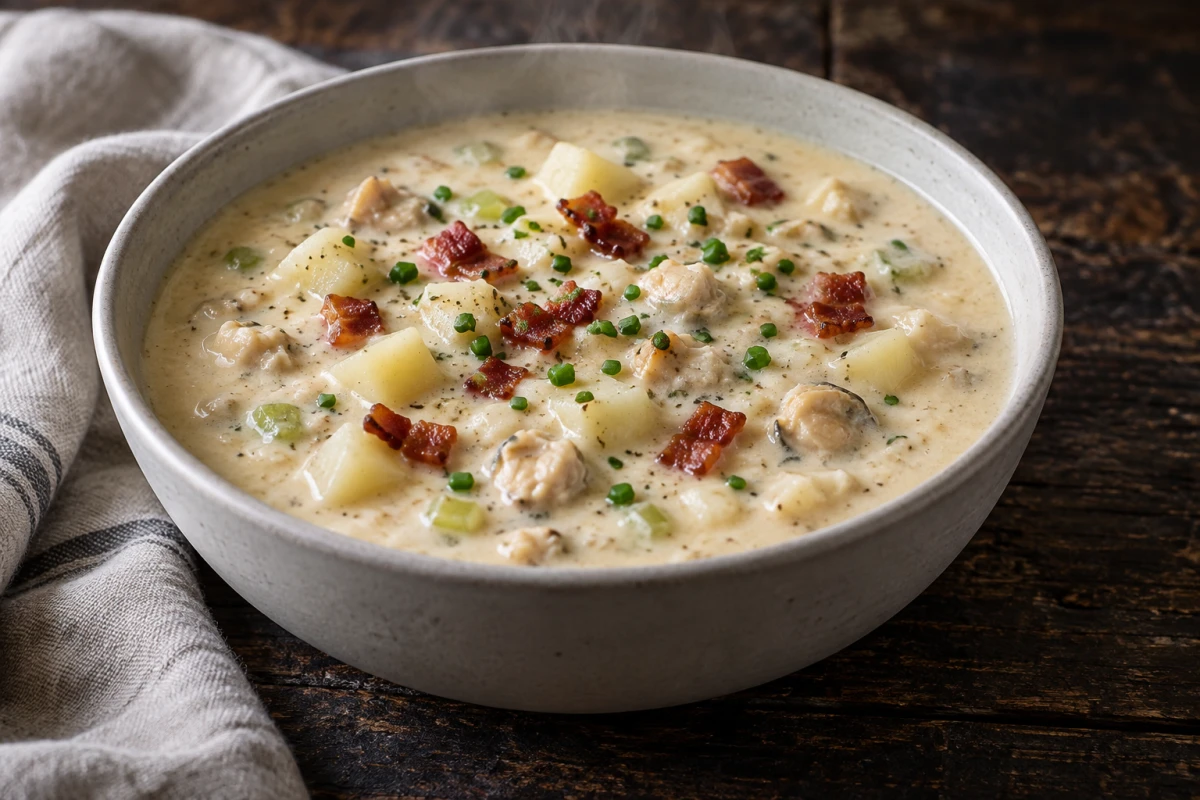
Creamy Clam Chowder with Potatoes
Potatoes, clams, and bacon in a velvety soup
This New England-inspired clam chowder combines tender diced potatoes, cooked clam meat, and crisp bacon in a velvety pale soup. Reserved clam juice adds ocean depth, while the clams are heated only briefly at the end so they remain tender.
- Prep time
- 25 minutes
- Cook time
- 40 minutes
- Total
- 1 hr 5 min
- Yield
- 4 main-course bowls of clam chowder, about 500 ml each
Ingredients
- 500 g gegartes Venusmuschelfleisch aus Dose oder Glas, abgetropft, Flüssigkeit aufgefangen
- 300 ml aufgefangener Muschelsud; bei zu geringer Menge mit natriumarmer Fischbrühe auf 300 ml ergänzen
- 150 g geräucherter durchwachsener Speck, in 8 mm großen Würfeln
- 20 g ungesalzene Butter
- 150 g gelbe Zwiebel, in 8 mm großen Würfeln
- 120 g Staudensellerie, in 8 mm großen Würfeln
- 35 g Weizenmehl Type 405
- 300 ml natriumarme Fischbrühe
- 400 ml Vollmilch, 3,5 % Fett
- 200 ml Schlagsahne, mindestens 30 % Fett
- 500 g festkochende Kartoffeln, geschält und in 1,5 cm großen Würfeln
- 2 Lorbeerblätter
- 2 g getrockneter Thymian
- 3 g feines Salz, zunächst zurückhaltend dosiert
- 1 g schwarzer Pfeffer, frisch gemahlen
- 15 ml frisch gepresster Zitronensaft
- 15 g frischer Schnittlauch, fein geschnitten
Instructions
- Drain the clams in a fine sieve set over a bowl. Measure exactly 300 ml clam juice, topping up with fish stock if necessary. Check the clam meat for shell fragments, cover, refrigerate, and use only at the end. Do not use swollen, leaking, or damaged cans or jars.
- Place the diced bacon in a cold heavy pot and render slowly over medium heat for 7–9 minutes until golden and crisp. Transfer to clean paper towels with a slotted spoon; leave about 20 g bacon fat in the pot and reserve or discard any excess appropriately.
- Add the butter, onion, and celery to the bacon fat. Cook over medium-low heat for 7–8 minutes, stirring occasionally, until soft and translucent without significant browning.
- Sprinkle in the flour and cook for 2 minutes while stirring constantly. Whisk in the clam juice and 300 ml fish stock in four additions, smoothing each addition completely and scraping the base before adding more liquid.
- Add the potatoes, bay leaves, thyme, an initial 2 g salt, and pepper. Bring to a boil, then simmer gently over low to medium heat for 12–15 minutes. Scrape across the bottom every 2–3 minutes. The potatoes are ready when a knife enters without a hard center while the cubes retain their shape.
- Stir in the milk and cream and slowly heat the soup to 75–80°C while stirring frequently. Do not boil vigorously, as the dairy may split and the flour-thickened soup can catch on the bottom.
- Add the chilled clam meat and heat very gently for 2–3 minutes. The soup must be steaming throughout and reach at least 74°C; immediately remove from the heat afterward so the clams do not become tough.
- Remove the bay leaves. Stir in the lemon juice, half the chives, and two thirds of the crisp bacon. Taste and add the remaining 1 g salt only if needed, because the clam juice, stock, bacon, and clams are already salty.
- Divide the chowder among four warmed bowls and distribute the remaining bacon and chives evenly on top. Serve immediately; bread, crackers, and any other unlisted sides are excluded from the nutrition basis.
Tips
- Strain the clam juice through a fine sieve and check the meat for shell fragments so no grit or hard pieces enter the soup.
- Render the bacon slowly from a cold pot so it releases enough clear fat for the vegetable base without burning.
- Whisk the liquid into the roux in batches and smooth every addition completely to prevent flour lumps.
- Heat the milk and cream only until gently steaming and scrape the base frequently; vigorous boiling harms both texture and flavor.
- Add the precooked clams only at the end and remove from the heat immediately after reaching 74°C so they remain tender.
Common mistakes
- Muscheln samt ungefiltertem Doseninhalt in den Topf geben → Flüssigkeit fein sieben und Fleisch einzeln auf Schalenreste prüfen.
- Speck bei hoher Hitze schwarz braten → kalt ansetzen und langsam goldbraun auslassen.
- Flüssigkeit auf einmal zur Mehlschwitze gießen → in vier Portionen glatt rühren, damit keine Klumpen entstehen.
- Kartoffeln stark kochen → nur sanft köcheln, sonst zerfallen sie außen, bevor der Kern gar ist.
- Milch-Sahne-Basis sprudelnd kochen → bei 75–80 °C halten und regelmäßig über den Boden rühren.
- Muscheln 10 Minuten mitkochen → erst für die letzten 2–3 Minuten zufügen und nach 74 °C sofort servieren.
Variations and substitutions
- Venusmuscheln aus Dose oder Glas: durch 500 g vollständig gegartes, ausgelöstes Miesmuschelfleisch ersetzen; das Aroma und die Textur werden kräftiger, Weichtiere bleiben Allergen.
- Fischbrühe: durch natriumarme Gemüsebrühe ersetzen; der Muschelsud bleibt für das charakteristische Aroma notwendig und Brühenetiketten sind auf Sellerie und Gluten zu prüfen.
- Kochspeck: durch 150 g geräucherten Truthahnspeck ersetzen und zusätzlich 10 ml neutrales Öl zum Dünsten verwenden; Nährwerte und Produktallergene ändern sich.
- Schlagsahne: durch 200 ml Kochsahne mit mindestens 15 % Fett ersetzen; die Suppe wird leichter und etwas weniger vollmundig.
- Laktosefrei: Butter, Vollmilch und Sahne durch vollfette laktosefreie Entsprechungen ersetzen; Milch bleibt deklarationspflichtiges Allergen.
- Glutenfrei: Weizenmehl durch 25 g Maisstärke ersetzen, diese in 100 ml kalter Milch aus der Gesamtmenge glatt rühren und nach dem Garen der Kartoffeln einarbeiten; Brühe, Speck und Konserven ausdrücklich glutenfrei wählen.
Storage and notes
Storage
Chowder wegen Muscheln, Milch und Kartoffeln sofort servieren und höchstens 2 Stunden ungekühlt stehen lassen. Reste zügig in flache Behälter füllen, auf höchstens 5 °C herunterkühlen und luftdicht maximal 1 Tag lagern. Nur einmal bei niedriger Hitze unter häufigem Rühren vollständig auf mindestens 74 °C erwärmen, nicht sprudelnd kochen und danach sofort verzehren. Bereits aufgewärmte Reste entsorgen. Einfrieren wird nicht empfohlen, weil Milchbasis ausflocken, Kartoffeln körnig und Muscheln zäh werden. Beschädigte oder aufgeblähte Muschelkonserven sowie Muscheln mit auffälligem Geruch konsequent entsorgen.
Allergens
Enthält Weichtiere, Fisch, Milch, Sellerie und Weizen/Gluten. Fischbrühe, Speck, Muschelkonserven und Milchprodukte können produktabhängig weitere deklarationspflichtige Allergene enthalten; Etiketten prüfen. Laktosefreie Milchprodukte ändern die Kennzeichnungspflicht für Milch nicht. Bei Gemüsebrühe als Ersatz bleibt das Weichtierallergen durch Muscheln und Sud bestehen.
Editorial context
This presentation and its supporting notes were edited for Rezepte daheim. It does not claim invention of the dish.
No personal kitchen test is currently documented for this version.