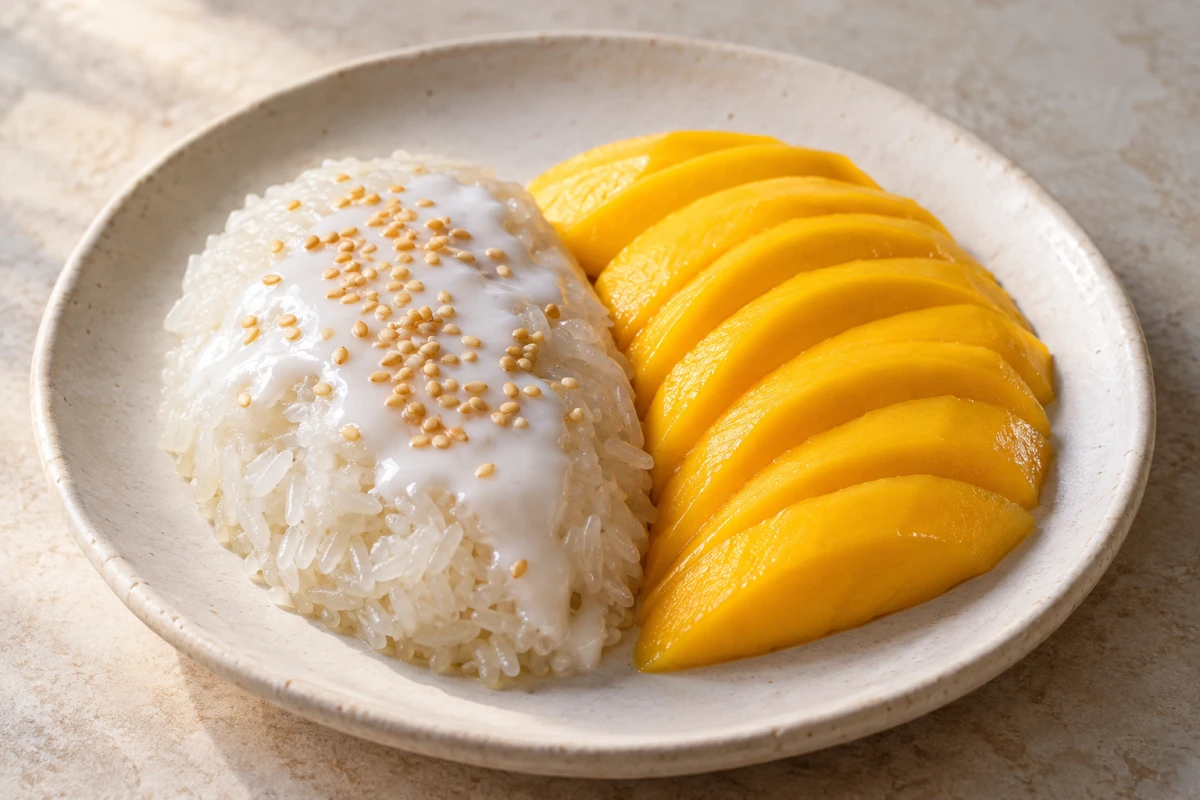
Thai Mango Sticky Rice with Coconut Sauce
Glutinous rice with ripe mango and sweet-salty coconut cream
This Thai-inspired mango sticky rice combines tender, chewy glutinous rice with warm palm-sugar coconut sauce, ripe mango, and a lightly salted coconut topping. Four hours of refrigerated soaking, gentle steaming, and a precisely timed absorption rest let the grains take up the sauce without becoming mushy.
- Prep time
- 20 minutes
- Cook time
- 35 minutes
- Rest time
- 4 hr 15 min
- Total
- 5 hr 10 min
- Yield
- Approximately 1.4 kg mango sticky rice, 4 dessert servings
Ingredients
- 240 g thailändischer weißer Klebreis, auch Glutinous Rice oder Sweet Rice, ausdrücklich kein Jasminreis
- 1 l kaltes Wasser zum Einweichen, wird vollständig abgegossen
- 1,2 l Wasser für den Dämpftopf, ohne Kontakt zum Reis
- 320 ml vollfette Kokosmilch mit mindestens 17 % Fett, vor dem Abmessen homogen verrührt und geteilt in 260 ml und 60 ml
- 80 g Palmzucker, fein gehackt und geteilt in 70 g und 10 g
- 4 g feines Salz, geteilt in 3 g und 1 g
- 8 g Speisestärke aus Mais
- 15 ml kaltes Wasser für die Stärkemischung
- 480 g reifes gelbes Mangofruchtfleisch, geschält und entsteint gewogen
- 12 g weißer Sesam
Instructions
- Wash the glutinous rice in a bowl with cold water four to five times, until the water is only lightly cloudy. Cover with exactly 1 liter of fresh cold water, cover the bowl, and soak for exactly 240 minutes in the refrigerator at no more than 5°C. These four hours are the first component of restTime.
- After 240 minutes, drain off all soaking water and shake the rice firmly in a fine sieve. Fill a steamer pot with 1.2 liters water; the water must not touch the rice later. Line the steamer insert with a clean damp steaming cloth, spread the rice in an even layer no more than 2 cm deep, and bring the water to a boil.
- Cover and steam the rice over strong steam for 25 minutes. After 12 minutes, use heatproof gloves to lift the cloth and turn the rice once for even cooking. Replace the lid immediately and monitor the water level without pouring cold water over the rice.
- While the rice steams, combine 260 ml coconut milk, 70 g palm sugar, and 3 g salt in a small saucepan. Heat over low to medium heat to 70–75°C while stirring, until the sugar and salt are fully dissolved. Do not let it boil; the mixture should remain smooth without splitting. Keep warm.
- Also during steaming, heat the remaining 60 ml coconut milk with 10 g palm sugar and 1 g salt. Stir the cornstarch with 15 ml cold water until smooth, whisk it in, and simmer the topping gently for 1–2 minutes until it lightly coats a spoon. Remove from the heat and keep covered and warm.
- During the final 3 minutes of steaming, toast the sesame in a dry small pan over medium heat, swirling constantly. It is ready when pale golden and nutty-smelling. Immediately transfer it to a cold plate. After 25 minutes, test one grain of rice: it must be translucent throughout, tender and chewy, with no white, chalky center.
- Immediately transfer the hot glutinous rice to a wide heatproof bowl. Gently fold in the warm palm-sugar coconut sauce in three additions without crushing the grains. Cover and leave at room temperature for exactly 15 minutes so the rice absorbs the sauce; this is the second component of restTime. Fluff gently once afterward.
- Only after the 15-minute absorption rest, cut the mango flesh into even slices about 5 mm thick. This final active task belongs to the total 20-minute prepTime and does not overlap the absorption rest. Keep the mango cool until immediately before plating.
- Divide the glutinous rice among four shallow dessert bowls. Fan exactly 120 g mango beside each serving, spoon one quarter of the thickened coconut topping over the rice, and sprinkle with exactly 3 g toasted sesame. Serve warm; no additional toppings or sides are included in the yield or nutrition.
Tips
- Use genuine Thai glutinous rice only. Jasmine, sushi, and risotto rice have different starch structures and will not produce the same chewy grains or liquid absorption.
- Soak the rice under refrigeration for exactly four hours and steam it in a layer no deeper than 2 cm; a thick layer turns soft outside while the center remains dry.
- Stir the coconut milk until completely homogeneous before measuring and heat it only to 70–75°C. A hard boil can separate the fat and water and make the sauce greasy.
- Fold the warm sauce into the hot rice immediately. If either component is cold, the coconut liquid absorbs unevenly and pools at the bottom of the bowl.
- Slice the mango only after the absorption rest and keep it cool until plating, so it stays fresh and does not release juice into the warm rice.
Common mistakes
- Jasmin- oder Milchreis verwenden → ausschließlich als Glutinous Rice, Sweet Rice oder Thai-Klebreis gekennzeichneten Reis kaufen.
- Einweichzeit abkürzen oder bei warmer Raumtemperatur durchführen → exakt 240 Minuten abgedeckt bei höchstens 5 °C einweichen.
- Reis im Wasser kochen → über Dampf garen und jeden Kontakt mit dem Wasser im Dämpftopf vermeiden.
- Eine dicke Reisschicht dämpfen und nicht wenden → höchstens 2 cm hoch verteilen und nach 12 Minuten einmal wenden.
- Kokosmilch sprudelnd kochen → nur sanft auf 70–75 °C erwärmen, damit sie nicht trennt.
- Kalte Sauce auf abgekühlten Reis geben → beide Komponenten warm verbinden und exakt 15 Minuten abgedeckt ziehen lassen.
- Gegarten Klebreis lange bei Raumtemperatur aufbewahren → sofort essen oder innerhalb 1 Stunde flach ausbreiten und auf höchstens 5 °C kühlen.
Variations and substitutions
- Palmzucker: durch insgesamt 80 g hellen braunen Zucker ersetzen, davon 70 g für den Reis und 10 g für das Topping; das karamellige Aroma wird schwächer.
- Maisstärke: durch 10 g Reismehl ersetzen, direkt mit den 60 ml kalten Kokosmilch glatt rühren und anschließend mit Zucker sowie Salz erhitzen; die Textur wird etwas weniger glänzend.
- Weißer Sesam: für eine sesamfreie Variante durch 12 g geröstete geschälte gelbe Mungbohnen ersetzen; Hülsenfrüchte kommen dadurch als mögliche individuelle Unverträglichkeit hinzu.
- Mango: durch 480 g reife Ananas in dünnen Scheiben ersetzen; Säure, Süße, Nährwerte und Rezeptbezeichnung ändern sich deutlich.
- Vollfette Kokosmilch: nicht durch Kokosdrink oder fettarme Pflanzenmilch ersetzen, da Fettgehalt und Bindung für Aufnahme und Mundgefühl notwendig sind.
- Klebreis: besitzt keinen verlässlichen 1:1-Ersatz. Mit Jasmin-, Sushi- oder Risottoreis muss ein anderes Garverfahren und ein anderes Rezept verwendet werden.
Storage and notes
Storage
Mango Sticky Rice möglichst unmittelbar nach der 15-minütigen Ziehzeit servieren. Gegarten Klebreis nicht länger als 1 Stunde bei Raumtemperatur stehen lassen. Für Reste Mango, Kokos-Topping und Reis getrennt lagern: Reis sofort dünn auf einem sauberen flachen Behälter verteilen, rasch ausdampfen lassen, abdecken und innerhalb 1 Stunde auf höchstens 5 °C kühlen. Alles höchstens bis zum nächsten Tag aufbewahren. Reis und Kokos-Topping nur einmal gemeinsam vollständig auf mindestens 74 °C erhitzen und anschließend kurz auf Esstemperatur abkühlen lassen; kalte Mango und Sesam erst danach zufügen. Bereits erwärmte Reste nicht erneut kühlen. Einfrieren wird wegen harter Reistextur und wässriger Mango nicht empfohlen.
Allergens
Enthält Sesam. Kokosnuss zählt in der EU nicht zu den 14 kennzeichnungspflichtigen Hauptallergenen, kann aber individuelle Reaktionen auslösen. Kokosmilch, Speisestärke, Palmzucker und Sesam können produktabhängig Spuren weiterer Allergene enthalten; für Vegan- und Glutenfrei-Kennzeichnung ausschließlich entsprechend kontrollierte Produkte verwenden. Bei der Mungbohnen-Substitution entfällt Sesam nur bei sicher sesamfreier Verarbeitung.
Editorial context
This presentation and its supporting notes were edited for Rezepte daheim. It does not claim invention of the dish.
No personal kitchen test is currently documented for this version.