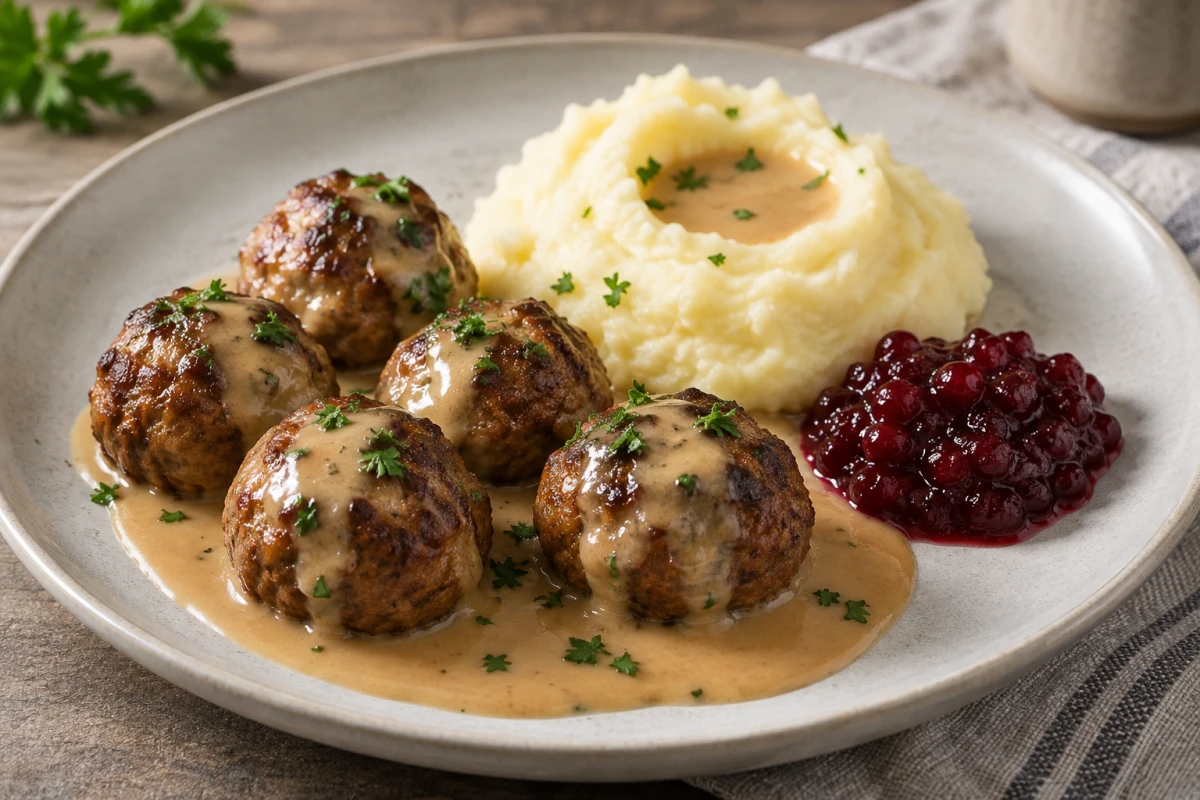
Swedish Meatballs with Mashed Potatoes
Tender meatballs in cream gravy with lingonberries
These Swedish-inspired meatballs pair juicy beef-and-pork meatballs with silky mashed potatoes, savory cream gravy, and tart lingonberry preserves. Precisely portioning the mixture, browning in two batches, and safely finishing the meatballs in the gravy produce even color without drying them out.
- Prep time
- 35 minutes
- Cook time
- 35 minutes
- Total
- 1 hr 10 min
- Yield
- 20 meatballs with mashed potatoes and cream gravy, 4 main-course servings
Ingredients
- 60 g feine Semmelbrösel aus Weizen
- 100 ml Vollmilch für die Fleischbällchen
- 350 g Rinderhackfleisch mit etwa 10 % Fett, durchgehend gekühlt
- 150 g Schweinehackfleisch, durchgehend gekühlt
- 100 g gelbe Zwiebel, sehr fein gerieben
- 55 g Ei, verquirlt, entsprechend 1 Ei Größe M ohne Schale
- 7 g feines Salz für die Fleischbällchen
- 1 g weißer Pfeffer, gemahlen
- 1 g Piment, gemahlen
- 0,5 g Muskatnuss, frisch gerieben, für die Fleischbällchen
- 15 g ungesalzene Butter zum Braten
- 10 ml neutrales Rapsöl zum Braten
- 800 g mehligkochende Kartoffeln, geschält gewogen und in 3 cm großen Stücken
- 150 ml Vollmilch für das Kartoffelpüree, auf 60–70 °C erwärmt
- 40 g ungesalzene Butter für das Kartoffelpüree, gewürfelt
- 5 g feines Salz für das Kartoffelpüree
- 0,5 g Muskatnuss, frisch gerieben, für das Kartoffelpüree
- 25 g ungesalzene Butter für die Rahmsauce
- 25 g Weizenmehl Type 405
- 400 ml natriumarmer Rinderfond
- 100 ml Schlagsahne mit 30 % Fett
- 15 g Dijon-Senf
- 2 g feines Salz für die Rahmsauce
- 0,5 g schwarzer Pfeffer, frisch gemahlen
- 80 g Preiselbeerkonfitüre, auf vier Portionen zu je 20 g verteilt
- 10 g glatte Petersilie, fein gehackt
Instructions
- Combine the breadcrumbs and 100 ml whole milk in a large bowl and leave to hydrate for 5 minutes. Meanwhile, prepare the potatoes, grate the onion, weigh the spices, and set out the remaining ingredients; this hydration runs entirely within the 35-minute preparation period and does not extend the total time.
- Add the chilled beef and pork mince, grated onion, egg, 7 g salt, white pepper, allspice, and 0.5 g nutmeg to the breadcrumb mixture. Mix with cold hands for only 45–60 seconds, just until evenly bound. Do not knead. Thoroughly clean hands, board, and utensils after contact with raw meat.
- Use a scale to divide the mixture into 20 portions of about 41 g each and shape them into smooth balls with lightly dampened hands. Keep covered at no more than 5°C until frying. Barely cover the prepared potatoes with cold water; do not heat them yet.
- At the start of the 35-minute cooking period, bring the potatoes to a boil over high heat, then simmer gently for 18–20 minutes. They are done when a knife slides to the center without resistance. At the same time, heat a large heavy frying pan with 15 g butter and 10 ml rapeseed oil over medium-high heat.
- Add ten meatballs and brown deeply on all sides for 6–7 minutes, turning regularly without flattening them. Transfer to a clean plate and fry the second batch in the same way. The centers do not need to have reached 71°C at this point because the meatballs will finish cooking in the gravy. Do not reuse the plate that held raw meatballs.
- Reduce the heat to medium. Melt 25 g butter in the pan drippings, stir in the flour, and cook the pale roux for 90 seconds while stirring. Whisk in the beef stock in four additions, smoothing each addition before the next. Simmer gently for 3–4 minutes until the gravy lightly coats a spoon. Stir in the cream, Dijon mustard, 2 g salt, and black pepper.
- Return all meatballs and their accumulated juices to the gravy and turn them at a gentle simmer for 6–8 minutes. Insert a thermometer sideways into the center of the thickest meatball: it must reach at least 71°C. Do not judge doneness by color alone. Hold over the lowest heat afterward without boiling the gravy hard.
- While the meatballs finish in the gravy, drain the potatoes and let them steam dry uncovered in the hot pot for 2 minutes. Pass them through a potato ricer or mash them finely. Work in 40 g butter, then fold in the 150 ml warm milk in additions. Season with 5 g salt and 0.5 g nutmeg. Mix only until smooth and fluffy; do not use an immersion blender.
- Divide the mashed potatoes among four warmed plates. Plate exactly five meatballs and one quarter of the cream gravy per serving. Add 20 g lingonberry preserves separately alongside each portion and sprinkle with the total 10 g parsley. Serve immediately; no further sides are included in the yield or nutrition.
Tips
- Keep the mince and shaped meatballs at no more than 5°C until just before frying; a cold mixture shapes neatly and remains food-safe.
- The hydrated breadcrumbs retain moisture. Mix the meat mixture only briefly because prolonged kneading develops the proteins and makes the meatballs dense.
- Weigh each portion to about 41 g for 20 evenly cooking meatballs; markedly different sizes make the stated cooking time unreliable.
- Brown in two batches with space between the meatballs. An overcrowded pan loses heat, collects liquid, and browns poorly.
- For fluffy mash, let floury potatoes steam dry, use warm milk, and mash or rice them only; blender blades make the starch gluey.
Common mistakes
- Fleischmasse lange und kräftig kneten → nur 45–60 Sekunden bis zur Bindung mischen, damit die Köttbullar locker bleiben.
- Bällchen nach Augenmaß stark unterschiedlich formen → 20 Portionen zu etwa 41 g abwiegen.
- Alle 20 Bällchen gleichzeitig braten → in zwei Chargen arbeiten, damit sie rösten statt im eigenen Saft zu dämpfen.
- Gebräunte Oberfläche mit sicher gegartem Kern verwechseln → in der Sauce fertig garen und am dicksten Bällchen mindestens 71 °C messen.
- Mehl nur kurz benetzen oder Fond auf einmal angießen → Roux 90 Sekunden garen und Fond portionsweise glatt einrühren, sonst schmeckt die Sauce mehlig oder klumpt.
- Kalte Milch in die Kartoffeln rühren oder einen Stabmixer verwenden → Milch auf 60–70 °C erwärmen und Kartoffeln pressen beziehungsweise stampfen.
- Dieselbe Platte für rohe und gegarte Bällchen verwenden → zum Zwischenlagern stets einen sauberen Teller nehmen und Rohfleischkontaktflächen reinigen.
Variations and substitutions
- Rind-Schwein-Mischung: durch 500 g Rinderhack mit etwa 15 % Fett ersetzen; die Köttbullar schmecken anders und können etwas fester werden, müssen aber ebenfalls mindestens 71 °C erreichen.
- Schweinefleischfreie Variante: 150 g Schweinehack durch 150 g Rinderhack ersetzen; alle übrigen Mengen bleiben gleich.
- Laktosefrei: Vollmilch, Butter und Sahne jeweils durch die gleiche Menge ausdrücklich laktosefreier Kuhmilchprodukte ersetzen; Milch bleibt als Allergen enthalten.
- Glutenfrei: Semmelbrösel durch 60 g glutenfreie feine Brösel und Mehl durch 25 g glutenfreie helle Mehlmischung ersetzen; zusätzlich Fond, Senf und Konfitüre als glutenfrei prüfen. Erst dann entfällt Weizen/Gluten als Allergen.
- Rinderfond: durch 400 ml natriumarmen Kalbsfond ersetzen; Salzgehalt und mögliche Sellerieallergene produktbezogen kontrollieren.
- Preiselbeerkonfitüre: durch 80 g Cranberrykonfitüre ersetzen; Geschmack und Zuckergehalt verändern sich, Nährwerte müssen neu berechnet werden.
- Dijon-Senf: durch 15 g mittelscharfen Senf ersetzen; Säure und Schärfe verändern sich, Senf bleibt Allergen.
Storage and notes
Storage
Rohes Hackfleisch bis zur Verarbeitung durchgehend bei höchstens 5 °C lagern und am Einkaufstag verbrauchen. Gegarte Köttbullar, Sauce und Kartoffelpüree nicht länger als 2 Stunden bei Raumtemperatur stehen lassen, anschließend getrennt in flachen, luftdichten Behältern rasch auf höchstens 5 °C kühlen und bis zu 2 Tage lagern. Köttbullar und Sauce gemeinsam bei kleiner Hitze unter Rühren mit 15–30 ml Wasser pro Portion einmal vollständig auf mindestens 74 °C erhitzen; Püree separat mit etwas Milch ebenfalls auf mindestens 74 °C bringen. Bereits erwärmte Reste nicht erneut kühlen. Köttbullar in Sauce ohne Püree bis zu 2 Monate einfrierbar; im Kühlschrank auftauen und vollständig durcherhitzen. Kartoffelpüree und Preiselbeerkonfitüre wegen Qualitätsverlust nicht zusammen einfrieren.
Allergens
Enthält Weizen/Gluten, Milch, Ei und Senf. Rinderfond kann Sellerie, Gluten oder weitere deklarationspflichtige Allergene enthalten; Preiselbeerkonfitüre kann produktabhängige Zusätze enthalten. Das Grundrezept enthält keine Schalenfrüchte, eine Nussfrei-Kennzeichnung setzt jedoch entsprechend kontrollierte Produkte und den Ausschluss von Kreuzkontamination voraus. Substitutionen können das Allergenprofil verändern.
Editorial context
This presentation and its supporting notes were edited for Rezepte daheim. It does not claim invention of the dish.
No personal kitchen test is currently documented for this version.