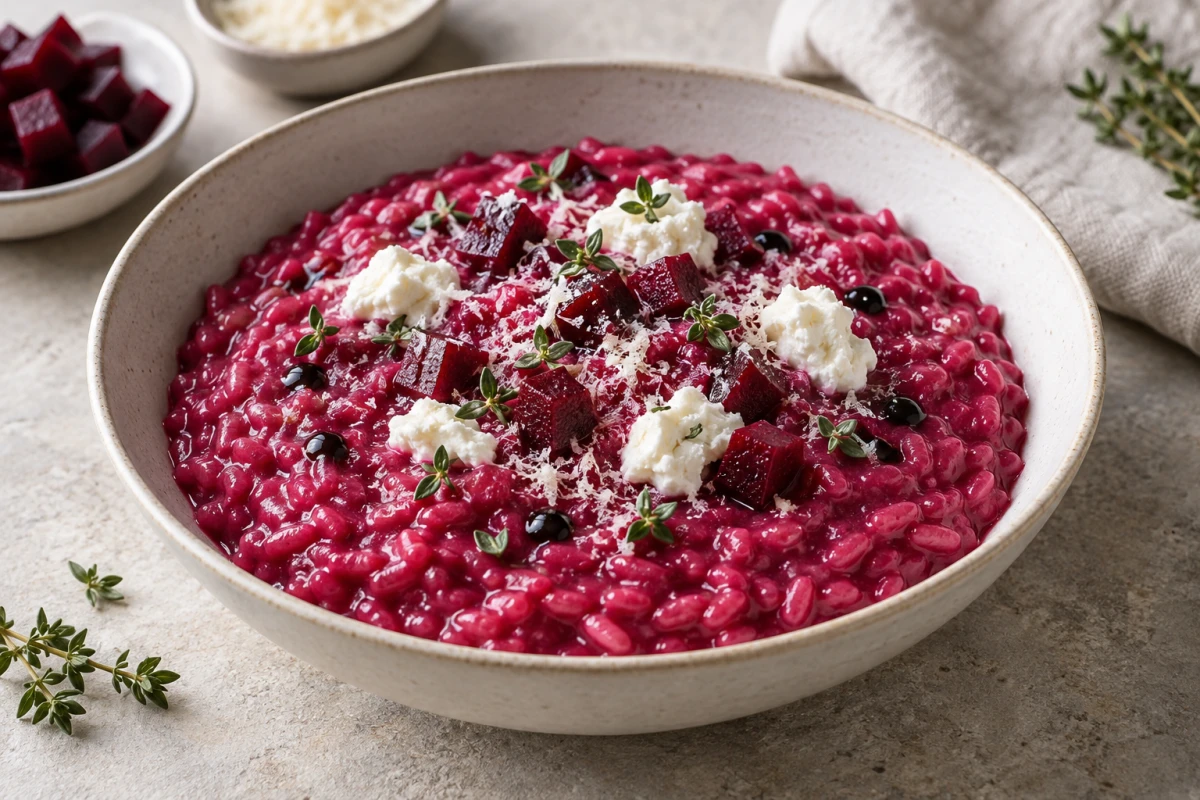
Creamy Beetroot Risotto with Goat Cheese
Silky and earthy with tangy goat cheese
Creamy Carnaroli risotto gets its vivid color and earthy sweetness from smoothly puréed beetroot, while soft goat cheese, thyme, and a few drops of balsamic add freshness and contrast. Hot stock, regular stirring, and a five-minute mantecatura rest produce al dente grains suspended in a flowing, silky sauce.
- Prep time
- 20 minutes
- Cook time
- 35 minutes
- Rest time
- 5 minutes
- Total
- 1 hr
- Yield
- Approximately 1.8 kg beetroot risotto, 4 main-course servings
Ingredients
- 320 g Carnaroli-Risottoreis, alternativ Arborio
- 500 g vorgegarte geschälte Rote Bete ohne Essig, abgetropft und geteilt
- 1 l natriumarme glutenfreie Gemüsebrühe
- 150 ml trockener Weißwein
- 120 g gelbe Zwiebel, sehr fein gewürfelt
- 12 g Knoblauch, fein gehackt
- 30 ml natives Olivenöl
- 40 g ungesalzene Butter, kalt gewürfelt
- 80 g vegetarischer italienischer Hartkäse mit mikrobiellem Lab, fein gerieben und geteilt
- 120 g Ziegenfrischkäse mit mikrobiellem Lab
- 15 ml Balsamico-Essig
- 10 g frische Thymianblätter, geteilt
- 5 g feines Salz, zusätzlich zum produktabhängigen Abschmecken
- 1 g schwarzer Pfeffer, frisch gemahlen und geteilt
Instructions
- Bring the vegetable stock to a boil in a saucepan, then keep it hot at 75–85°C just below a simmer. It must not cool during cooking but should not reduce vigorously.
- Blend 300 g beetroot with 200 ml of the hot stock in a tall container until completely smooth. Cut the remaining 200 g beetroot into even 1 cm cubes. Reserve 20 g hard cheese and all the goat cheese for serving.
- Heat the olive oil in a wide, heavy pot over medium heat. Cook the onion with 2 g salt for 5–6 minutes until translucent without browning. Add the garlic and cook for 30 seconds while stirring.
- Add the dry, unwashed risotto rice and stir for 2 minutes, until the edges of the grains look slightly translucent while the centers remain white. Deglaze with the white wine and stir for 2–3 minutes, until the harsh alcohol aroma has disappeared and almost no free liquid remains.
- Add a first ladle of about 150 ml hot stock. Cook over medium heat, regularly scraping across the bottom with a wooden spoon. Add more liquid only when the previous addition is almost absorbed and a drawn line closes slowly.
- Continue adding stock in portions of about 100–150 ml. After 12 minutes total rice cooking time, stir in the beetroot purée in three additions, alternating it with the remaining stock. Stir more frequently from this point so the natural sugars do not catch on the base.
- Fold in the diced beetroot after 18 minutes cooking. Cook for 20–22 minutes in total, until the grains are creamy outside, still distinctly al dente at the center, and suspended in a flowing sauce. Reserve up to 100 ml stock if the correct consistency is reached early; use it all if needed. Season according to the products with the remaining 3 g salt and 0.5 g pepper.
- Remove the pot completely from the heat. Vigorously stir in the cold butter, 60 g hard cheese, 10 ml balsamic, and 7 g thyme for 60–90 seconds, until glossy and flowing in a soft wave when the pot is tilted. Cover and rest for exactly 5 minutes; it will thicken.
- After resting, check the consistency and stir in reserved hot stock one tablespoon at a time if needed. Immediately divide among four preheated shallow bowls. Finish each evenly with 30 g goat cheese and the remaining 20 g hard cheese, 5 ml balsamic, 3 g thyme, and 0.5 g pepper. Serve without salad, bread, nuts, or other sides.
Tips
- Do not rinse Carnaroli or Arborio rice; its surface starch is needed for the risotto's natural binding.
- Keep the stock just below a simmer. Cold stock interrupts cooking, while a vigorous boil evaporates liquid and changes the measured quantity.
- Add liquid gradually and stir regularly but not aggressively without pause; this releases starch and creates a creamy sauce without breaking the grains.
- Add the beetroot purée only from minute 12 and scrape the base more frequently afterward because its natural sugars catch more easily.
- Always perform the mantecatura off the heat and rest for five minutes; restore a flowing consistency afterward with hot stock if needed.
Common mistakes
- Risottoreis waschen → trocken und ungewaschen verwenden, damit die Oberflächenstärke erhalten bleibt.
- Kalte oder stark eingekochte Brühe verwenden → bei 75–85 °C heiß halten.
- Gesamte Flüssigkeit auf einmal angießen → portionsweise nachlegen, sobald die vorige Kelle fast aufgenommen ist.
- Rote-Bete-Püree von Beginn an kochen → erst nach 12 Minuten einarbeiten, sonst setzt Zucker an und Reis gart schwer kontrollierbar.
- Ausschließlich nach Minuten entscheiden → ab Minute 20 Korn und Fließfähigkeit prüfen; Reis muss innen al dente bleiben.
- Butter und Käse auf voller Hitze einrühren → Topf vollständig vom Herd ziehen, sonst trennt sich Fett und Käse wird zäh.
- Nach der Ruhezeit dickes Risotto servieren → bei Bedarf esslöffelweise heiße Restbrühe einarbeiten; es soll weich auf dem Teller verlaufen.
Variations and substitutions
- Carnaroli: durch 320 g Arborio ersetzen; ab Minute 18 häufiger probieren, da Arborio schneller weich werden kann.
- Weißwein: durch 150 ml zusätzliche natriumarme Gemüsebrühe ersetzen und die abschließende Balsamico-Menge von 15 auf 20 ml erhöhen; Sulfite können je nach Essig weiterhin enthalten sein.
- Ziegenfrischkäse: durch 120 g milden Feta mit mikrobiellem Lab ersetzen; Salz erst nach der Mantecatura anpassen, Milch bleibt Allergen.
- Vegetarischer Hartkäse: durch dieselbe Menge anderen gereiften Hartkäse mit ausdrücklich mikrobiellem Lab ersetzen; echter Parmigiano Reggiano ist wegen tierischen Labs nicht für die vegetarische Kennzeichnung geeignet.
- Vorgegarte Rote Bete: nicht 1:1 durch rohe Knollen ersetzen, ohne Zeit und Verfahren anzupassen. Für dieses 60-Minuten-Rezept ausschließlich vorgegarte, ungewürzte Ware verwenden.
- Alkoholfrei: alkoholfreien trockenen Weißwein nur verwenden, wenn er frei von nicht deklarierten Aromen ist; Zutatenetikett auf Sulfite prüfen.
Storage and notes
Storage
Risotto wegen des gekochten Reises nicht länger als 1 Stunde bei Raumtemperatur stehen lassen. Reste flach auf einem sauberen Blech oder in einem flachen Behälter verteilen, rasch ausdampfen lassen, abdecken und innerhalb dieser Stunde auf höchstens 5 °C kühlen. Luftdicht höchstens bis zum nächsten Tag lagern. Nur einmal in einem Topf mit etwas Wasser oder Brühe unter häufigem Rühren vollständig auf mindestens 74 °C erhitzen und sofort essen; bereits aufgewärmte Reste nicht erneut kühlen. Ziegenkäse nach dem Öffnen durchgehend kalt und gemäß Produktangabe lagern. Wegen deutlichen Texturverlusts nicht einfrieren. Rote-Bete-Saft färbt stark; nicht poröse Bretter verwenden und Spritzer sofort abwischen.
Allergens
Enthält Milch. Weißwein und Balsamico können Sulfite enthalten; Gemüsebrühe kann Sellerie, Gluten oder weitere deklarationspflichtige Allergene enthalten. Für die Glutenfrei-Kennzeichnung nur ausdrücklich glutenfreie Brühe verwenden. Hart- und Ziegenkäse müssen für die vegetarische Kennzeichnung mikrobielles statt tierisches Lab enthalten. Das Grundrezept enthält keine Schalenfrüchte; Kreuzkontamination und Ersatzprodukte produktbezogen prüfen.
Editorial context
This presentation and its supporting notes were edited for Rezepte daheim. It does not claim invention of the dish.
No personal kitchen test is currently documented for this version.