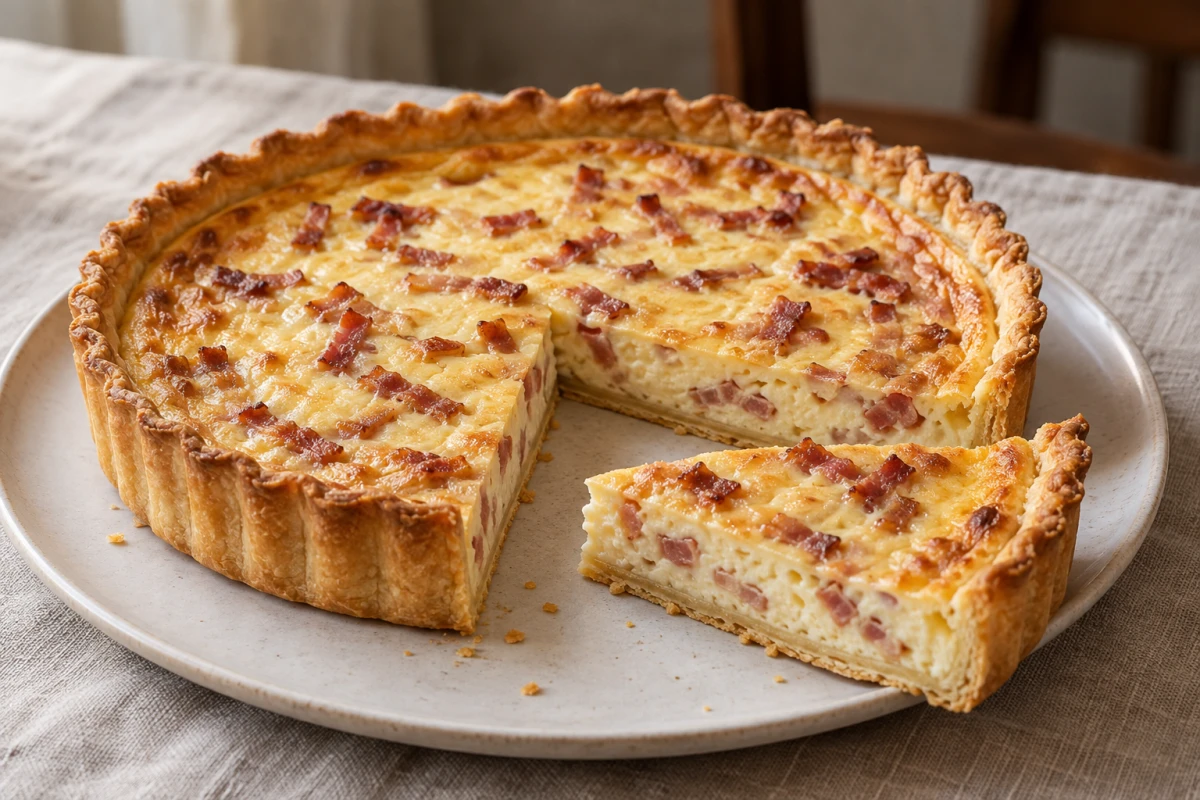
Classic Quiche Lorraine with Bacon
Buttery pastry with a silky egg-and-cream filling
A crisp, blind-baked pastry shell holds a silky egg-and-cream custard with golden rendered bacon. This French-inspired Quiche Lorraine deliberately contains no cheese; controlled oven heat and a brief setting time keep the filling creamy rather than dry.
- Prep time
- 30 minutes
- Cook time
- 55 minutes
- Rest time
- 45 minutes
- Total
- 2 hr 10 min
- Yield
- 1 quiche from a 28 cm tart pan, cut into 8 slices
Ingredients
- 250 g Weizenmehl Type 405
- 125 g kalte ungesalzene Butter, in 1 cm großen Würfeln
- 4 g feines Salz für den Teig
- 1 Ei, Größe M, etwa 50 g ohne Schale, kalt
- 15 ml Eiswasser
- 10 g weiche Butter zum Fetten der Form
- 250 g geräucherter durchwachsener Speck, Schwarte entfernt, in 5 mm breiten Stiften
- 3 Eier, Größe M, etwa 150 g ohne Schale
- 2 Eigelb, Größe M, etwa 36 g
- 250 ml Schlagsahne, mindestens 30 % Fett
- 150 ml Vollmilch, 3,5 % Fett
- 2 g feines Salz für den Guss
- 1 g weißer Pfeffer, frisch gemahlen
- 0,5 g Muskatnuss, frisch gerieben
- Backpapier und etwa 750 g Keramik-Backgewichte oder trockene Hülsenfrüchte zum Blindbacken (wiederverwendbares Hilfsmittel, nicht zum Verzehr bestimmt)
Instructions
- Mix the flour with 4 g salt. Quickly rub in the cold butter cubes with your fingertips until mostly pea-sized pieces remain. Add one cold egg and 15 ml ice water, mixing only until the dough holds together when pressed; do not knead it smooth. Shape into a 2 cm-thick disc, cover airtight, and chill for exactly 30 minutes.
- During the chilling time, lightly grease a 28 cm metal tart pan with a removable base using 10 g butter. Preheat the oven in time to 190°C conventional or 170°C fan; conventional heat is preferred.
- Roll the dough on a lightly floured surface into a 32–33 cm circle about 3 mm thick. Lay it loosely in the pan without stretching it, press it against the base and sides, and trim the overhang flush. Prick the base several times with a fork. Line with baking parchment and fill with weights right up to the edge.
- Blind-bake the pastry on the lower-middle rack for 15 minutes. Carefully remove the parchment and weights, then bake for another 5 minutes until the base is dry and the edges are pale golden. Leave the pan on the baking sheet. Reduce the oven to 175°C conventional or 155°C fan.
- While the shell blind-bakes, spread the bacon in a cold, wide frying pan. Cook over medium heat for 8–10 minutes, turning occasionally, until golden but not hard. Transfer to paper towels with a slotted spoon. Do not add the rendered fat to the filling.
- Stir three eggs, two egg yolks, cream, milk, 2 g salt, white pepper, and nutmeg just until smooth; do not whisk until foamy. Spread the bacon evenly over the prebaked shell. Slowly pour over the custard, leaving a 5 mm rim. If the particular pan cannot hold all the custard, do not overfill it.
- Bake the quiche at the reduced temperature for 33–38 minutes. It is ready when the outer filling is set and slightly puffed, the center area of about 5 cm still trembles gently when nudged, and the core reaches 72–75°C; it must neither slosh nor brown heavily.
- Let the quiche set in the pan on a wire rack for 15 minutes. Carefully release the ring, cut into eight slices, and serve warm. Any unlisted salad or other side is optional and is not included in the nutrition values.
Tips
- Keep the pastry ingredients cold and mix only until the dough holds together; visible butter pieces create flaky, tender layers.
- Do not stretch the dough into the pan, because tension makes it shrink substantially during baking.
- Fill the baking weights right up to the edge so they support the pastry wall.
- Stir the custard only until combined: incorporated air creates bubbles and a spongier texture.
- Remove the quiche while the center still trembles gently; residual heat finishes cooking it during the 15-minute setting time.
Common mistakes
- Warmen, überkneteten Teig verwenden → rasch arbeiten, 30 Minuten kühlen und nicht glatt kneten.
- Ohne Gewichte blindbacken → Boden kann sich wölben und der Rand abrutschen; Papier und 750 g Gewichte verwenden.
- Speckfett komplett in den Guss geben → Speck abtropfen lassen, sonst wird die Füllung fettig und übermäßig salzig.
- Den Guss schaumig schlagen → lediglich glatt rühren, damit die Textur dicht und seidig bleibt.
- Bis zur vollständig festen Mitte backen → bei 72–75 °C und feinem Wackeln herausnehmen; Überbacken macht den Guss trocken und körnig.
- Sofort anschneiden → 15 Minuten setzen lassen, damit saubere Stücke entstehen.
Variations and substitutions
- Speck: durch 250 g ungeräucherten Pancetta ersetzen; wegen geringerem Raucharoma verändert sich der Charakter, Salz erst nach Produktprüfung dosieren.
- Vollmilch: durch 150 ml weitere Schlagsahne ersetzen; die Füllung wird reichhaltiger, die Nährwerte ändern sich.
- Type 405: durch Type 550 ersetzen und bei Bedarf zusätzlich höchstens 5 ml Eiswasser einarbeiten.
- Laktosefrei: Butter, Sahne und Milch jeweils durch vollfette laktosefreie Entsprechungen ersetzen.
- Glutenfrei ist keine sichere 1:1-Umstellung: Eine erprobte glutenfreie Mürbeteigmischung nach Packungsangabe verwenden; Roll- und Backverhalten sowie Allergenprofil ändern sich.
- Keinen Käse hinzufügen, wenn das Rezept als diese klassische, käsefreie Variante dargestellt und mit den angegebenen Nährwerten veröffentlicht wird; eine Käsezugabe verändert Geschmack, Setzverhalten, Bild und Nährwerte.
Storage and notes
Storage
Quiche höchstens 2 Stunden bei Raumtemperatur stehen lassen. Reste zügig abkühlen, luftdicht verpacken und bei höchstens 5 °C bis zu 3 Tage lagern. Zum Servieren 12–15 Minuten bei 160 °C vollständig auf mindestens 74 °C Kerntemperatur erwärmen; nur einmal wiedererwärmen. Einzelne vollständig abgekühlte Stücke bis zu 2 Monate einfrieren, über Nacht im Kühlschrank auftauen und im Ofen erhitzen. Rohe Eierfüllung nicht aufbewahren. Backgewichte beziehungsweise zum Blindbacken eingesetzte Hülsenfrüchte nicht als Lebensmittel weiterverwenden.
Allergens
Enthält Weizen/Gluten, Ei und Milch. Geräucherter Speck kann je nach Produkt weitere deklarationspflichtige Zutaten oder Spuren enthalten; Etikett prüfen. Bei Ersatzprodukten das jeweils veränderte Allergenprofil neu bewerten.
Editorial context
This presentation and its supporting notes were edited for Rezepte daheim. It does not claim invention of the dish.
No personal kitchen test is currently documented for this version.