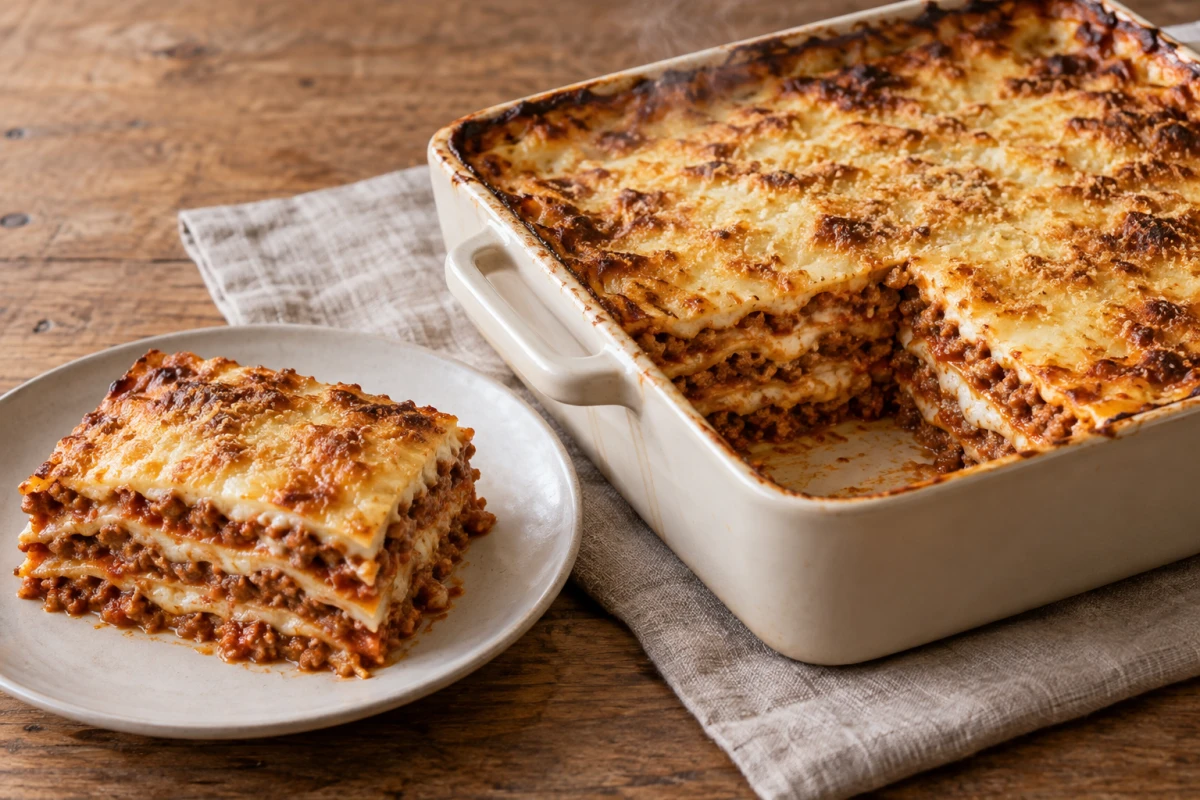
Lasagne Bolognese with Béchamel Sauce
Slow-cooked ragù layered with pasta and creamy béchamel
Rich beef ragù, silky béchamel, and thin lasagne sheets bake into eight juicy, stable portions. Careful reduction prevents a watery lasagne, while Parmesan and a twenty-minute setting time create a golden top and cleanly sliceable layers.
- Prep time
- 40 minutes
- Cook time
- 1 hr 50 min
- Rest time
- 20 minutes
- Total
- 2 hr 50 min
- Yield
- 1 lasagne from an approximately 23 × 33 cm baking dish, cut into 8 main-course portions
Ingredients
- 20 ml natives Olivenöl
- 150 g gelbe Zwiebel, fein gewürfelt
- 100 g Karotten, fein gewürfelt
- 100 g Staudensellerie, fein gewürfelt
- 12 g Knoblauch, fein gehackt
- 750 g Rinderhackfleisch, höchstens 20 % Fett
- 30 g Tomatenmark
- 150 ml trockener Rotwein
- 800 g stückige Tomaten aus der Dose
- 250 ml natriumarme Rinderbrühe
- 2 Lorbeerblätter
- 2 g getrockneter Oregano
- 8 g feines Salz für das Ragù, geteilt
- 1 g schwarzer Pfeffer, frisch gemahlen
- 70 g ungesalzene Butter
- 70 g Weizenmehl Type 405
- 900 ml Vollmilch, 3,5 % Fett, handwarm
- 5 g feines Salz für die Béchamel
- 0,5 g Muskatnuss, frisch gerieben
- 250 g trockene Lasagneblätter ohne Vorkochen, passend für etwa 12 Blätter
- 150 g Parmesan, fein gerieben und geteilt
Instructions
- Heat the olive oil in a large heavy pot over medium heat. Cook the onion, carrot, celery, and 3 g of the ragù salt for 8–10 minutes until soft with the first golden spots. Add the garlic and cook for 30 seconds.
- Increase the heat to medium-high. Add the minced beef in three batches, spreading each batch flat and leaving it undisturbed for 2 minutes before breaking it up. Cook for 10–12 minutes in total, until no pink areas remain, released liquid has evaporated, and the meat has browned patches. Use separate utensils for raw meat and ready-to-eat ingredients.
- Stir in the tomato paste and cook for 2 minutes. Deglaze with the red wine, scrape up the browned bits, and boil for 3–4 minutes until the harsh alcohol aroma is gone and the liquid has reduced by about half.
- Stir in the canned tomatoes, beef stock, bay leaves, oregano, remaining 5 g ragù salt, and pepper. Bring to a boil, then simmer uncovered over low to medium heat for 40–45 minutes. Scrape across the bottom every 8–10 minutes. The ragù is ready when it drops thickly from a spoon, a drawn line remains visible for several seconds, and no watery liquid pools at the edge. Remove the bay leaves. The beef must have reached at least 71°C.
- During the final 15 minutes of simmering the ragù, make the béchamel. Melt the butter in a second saucepan over medium heat. Stir in the flour and cook for 2 minutes, stirring without browning. Vigorously whisk in the lukewarm milk in five additions, smoothing the mixture completely before each addition.
- Bring the béchamel to a boil while stirring frequently, then simmer gently for 6–8 minutes until it clearly coats the back of a spoon but still flows. Stir in 5 g salt and the nutmeg. Remove from the heat and cover directly on the surface if assembly does not begin immediately.
- Preheat the oven to 190°C conventional or 170°C fan. Prepare an approximately 23 × 33 cm baking dish at least 6 cm deep. Spread 150 g ragù thinly over the base. Add a layer of about three lasagne sheets without substantial overlap, breaking sheets to fit if necessary.
- For each of the next three layers, distribute one quarter of the remaining ragù, 180 g béchamel, about three lasagne sheets, and 25 g Parmesan. Finish with the fourth sheet layer. Spread the final quarter of ragù, the remaining béchamel, and remaining 75 g Parmesan evenly over it. Every dry pasta edge must be completely covered with sauce.
- Set the dish on a baking sheet and cover loosely with baking parchment, then aluminum foil; the foil should not touch the food. Bake for 25 minutes. Carefully remove the covering away from your body and bake for another 15–20 minutes. The lasagne is ready when the edges bubble vigorously, a knife passes through the pasta center without hard resistance, the top is golden, and the center reaches at least 74°C.
- Remove the lasagne from the oven and leave it uncovered on a heatproof surface to set for exactly 20 minutes. Cut into eight equal rectangles and serve without unlisted sides.
Tips
- Brown the minced beef in batches and leave each batch for two minutes before breaking it up; an overcrowded pan or pot steams the meat gray.
- Reduce the ragù to the clearly described thick consistency. Thin ragù is the most common cause of slippery, watery layers.
- Whisk lukewarm milk into the roux in batches; adding a large quantity of cold milk creates lumps more easily.
- Cover every dry edge of the lasagne sheets completely with sauce so it softens in the oven.
- The 20-minute setting time is part of the recipe: only then do the layers remain stable when cut while still staying juicy.
Common mistakes
- Hackfleisch auf einmal in den Topf geben → in drei Portionen kräftig bräunen, Flüssigkeit jeweils verdampfen lassen.
- Ragù nur kurz erwärmen → 40–45 Minuten offen reduzieren, bis keine freie wässrige Phase bleibt.
- Mehl in der Béchamel roh lassen → Mehlschwitze vor der Milch 2 Minuten garen und Sauce anschließend 6–8 Minuten köcheln.
- Sauce und Pasta ungleich verteilen → vier vollständige Blattlagen aufbauen und alle trockenen Kanten bedecken.
- Form zu flach füllen → mindestens 6 cm tiefe Form verwenden und auf ein Blech stellen, um Überlaufen auf den Ofenboden zu vermeiden.
- Nur nach Bräunung urteilen → zusätzlich weiche Pasta, kräftiges Blubbern und mindestens 74 °C in der Mitte prüfen.
- Sofort portionieren → exakt 20 Minuten setzen lassen, sonst laufen die Schichten auseinander.
Variations and substitutions
- Rotwein: durch 150 ml zusätzliche natriumarme Rinderbrühe plus 10 ml Rotweinessig ersetzen; Säure und Tiefe verändern sich, Sulfite können entfallen.
- Rinderhack: durch 750 g gemischtes Hackfleisch aus Rind und Schwein ersetzen und ebenfalls mindestens 71 °C erreichen; Fettgehalt und Nährwerte ändern sich.
- Rinderbrühe: durch dieselbe Menge natriumarme Gemüsebrühe ersetzen; beide Produkte auf Sellerie und Gluten prüfen.
- Parmesan: durch dieselbe Menge fein geriebenen Grana Padano ersetzen; Milch bleibt Allergen.
- Laktosefrei: Butter und Vollmilch durch vollfette laktosefreie Entsprechungen ersetzen; lange gereifter Parmesan ist häufig sehr laktosearm, muss aber produktbezogen geprüft werden.
- Glutenfrei: nur ausdrücklich glutenfreie Lasagneblätter verwenden und die 70 g Weizenmehl in der Béchamel durch 55 g Maisstärke ersetzen, die zunächst in 150 ml kalter Milch glatt gerührt und in die übrige heiße Milch gegeben wird; Garzeit der Pasta nach Packungsangabe prüfen.
Storage and notes
Storage
Lasagne höchstens 2 Stunden bei Raumtemperatur stehen lassen. Reste in flachere Portionen teilen, zügig abkühlen, luftdicht verpacken und bei höchstens 5 °C bis zu 3 Tage lagern. Nur einmal vollständig auf mindestens 74 °C Kerntemperatur erwärmen, im Ofen abgedeckt bei 170 °C typischerweise 20–25 Minuten. Einzelportionen nach vollständigem Abkühlen bis zu 3 Monate einfrieren, über Nacht im Kühlschrank auftauen und anschließend durcherhitzen. Rohe Hackfleischreste getrennt halten, Arbeitsflächen und Hände sofort reinigen. Bereits aufgewärmte Reste nicht erneut kühlen.
Allergens
Enthält Weizen/Gluten, Milch und Sellerie. Rotwein enthält üblicherweise Sulfite; Rinderbrühe kann Sellerie, Gluten oder weitere deklarationspflichtige Allergene enthalten. Parmesan enthält Milch. Ersatzprodukte stets einzeln prüfen und das Allergenprofil bei Änderungen aktualisieren.
Editorial context
This presentation and its supporting notes were edited for Rezepte daheim. It does not claim invention of the dish.
No personal kitchen test is currently documented for this version.