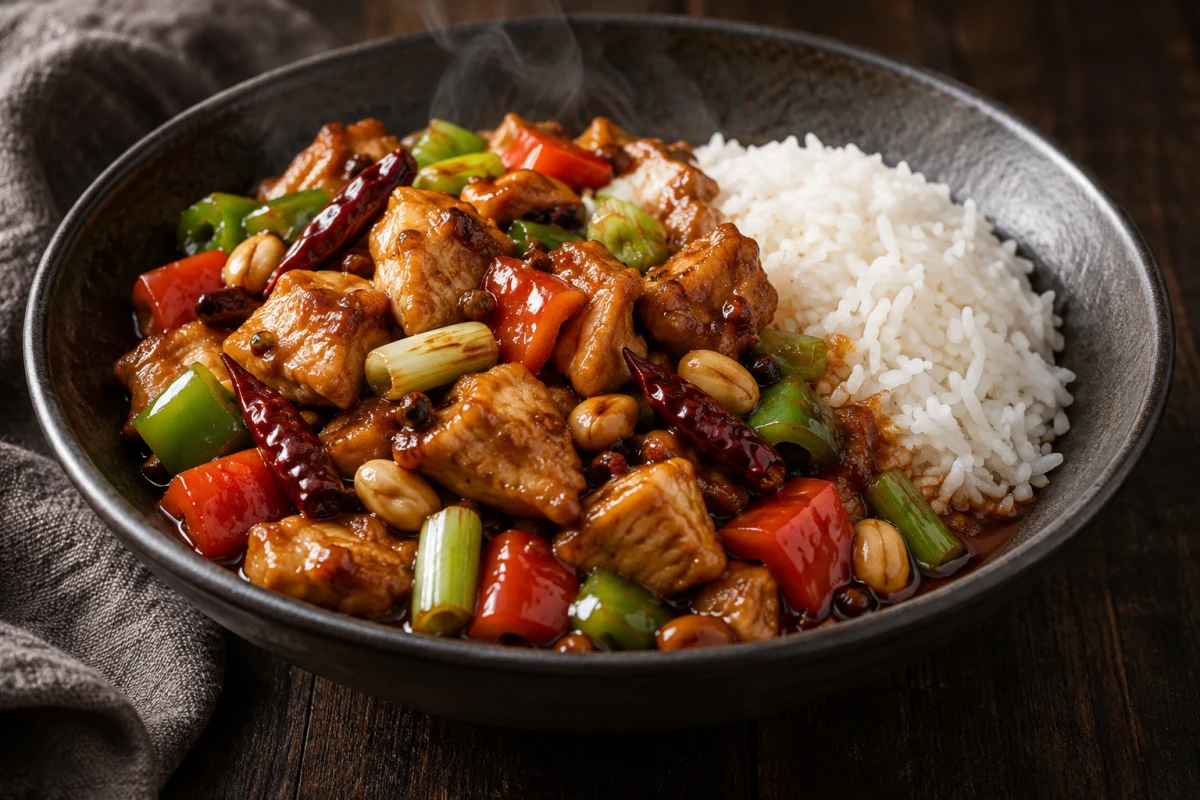
Kung Pao Chicken with Rice
Juicy chicken, crisp peppers, and peanuts in a savory-tangy sauce
This Chinese-inspired Kung Pao chicken combines juicy seared chicken thigh with peppers, spring onions, roasted peanuts, and a balanced sauce of soy sauce, Chinese black rice vinegar, and Shaoxing rice wine. Dried chilies and Sichuan pepper provide controlled heat and gentle numbing spice, while steamed jasmine rice absorbs the sauce.
- Prep time
- 25 minutes
- Cook time
- 30 minutes
- Rest time
- 10 minutes
- Total
- 1 hr 5 min
- Yield
- 4 main-course bowls of Kung Pao chicken with jasmine rice
Ingredients
- 280 g Jasminreis
- 420 ml kaltes Wasser
- 3 g feines Salz
- 600 g ausgelöste Hähnchenoberkeulen ohne Haut, in 2 cm großen Würfeln
- 15 ml natriumarme Sojasauce für die Marinade
- 15 ml Shaoxing-Reiswein für die Marinade
- 10 g Speisestärke für die Marinade
- 40 ml natriumarme Sojasauce
- 30 ml chinesischer schwarzer Reisessig (Chinkiang-Essig)
- 15 ml Shaoxing-Reiswein
- 20 g brauner Zucker
- 10 g Speisestärke
- 80 ml kaltes Wasser
- 25 ml neutrales Rapsöl, geteilt
- 150 g rote Paprika, entkernt und in 2 cm große Stücke geschnitten
- 150 g grüne Paprika, entkernt und in 2 cm große Stücke geschnitten
- 80 g Frühlingszwiebeln, weiße und grüne Teile getrennt in 2 cm langen Stücken
- 20 g frischer Ingwer, fein gehackt
- 15 g Knoblauch, fein gehackt
- 8 g ganze getrocknete rote Chilis, Stiele entfernt und quer halbiert
- 3 g Sichuanpfefferkörner
- 80 g ungesalzene geröstete Erdnüsse
Instructions
- Rinse the jasmine rice in a fine sieve under cold water until the water runs almost clear, then drain thoroughly. Combine the rice, 420 ml water, and 3 g salt in a saucepan, cover, and bring to a boil. Immediately reduce the heat to its lowest setting and cook gently for 15 minutes without lifting the lid.
- Remove the pan from the heat and let the rice rest, still covered, for exactly 10 minutes. Fluff once with a fork, cover again, and keep warm. Keep the lid closed throughout cooking and resting so the water is fully absorbed.
- While preparing the rice, evenly mix the chicken cubes with 15 ml soy sauce, 15 ml Shaoxing rice wine, and 10 g cornstarch. Keep covered in the refrigerator until frying; do not marinate for longer than 30 minutes.
- For the sauce, whisk 40 ml soy sauce, Chinese black rice vinegar, 15 ml Shaoxing rice wine, brown sugar, 10 g cornstarch, and 80 ml cold water until completely smooth. Whisk again immediately before adding because the starch settles.
- Toast the Sichuan peppercorns in a dry wok or large heavy frying pan over medium heat for 60–90 seconds until fragrant but not dark. Remove, cool, and coarsely crush in a mortar. Wipe out the wok and arrange every ingredient within reach.
- Heat the wok until very hot, add 15 ml rapeseed oil, and spread the marinated chicken in a single layer. Leave undisturbed for 2 minutes, then stir-fry for another 3–4 minutes. Transfer to a clean plate once browned outside; it will finish cooking later. The plate and tongs must not touch the previously raw chicken.
- Add the remaining 10 ml rapeseed oil to the wok. Stir the dried chilies and crushed Sichuan pepper for 20–30 seconds, only until fragrant. Immediately add both peppers and the white spring onion pieces, then stir-fry over high heat for 2–3 minutes until charred in spots but still crisp. Stir in the ginger and garlic for 30 seconds.
- Return the chicken and any collected juices. Whisk the sauce again, pour it around the edge of the wok, and boil for 2–3 minutes until glossy and thinly coating every piece. The thickest chicken piece must reach at least 75°C internally; otherwise continue stir-frying.
- Remove the wok from the heat and fold in the peanuts and green spring onion pieces. Remove the dried chilies before serving milder portions if desired. Divide the rice among four bowls and add exactly one quarter of the Kung Pao chicken on or beside each portion; do not add unlisted sides.
Tips
- Do not uncover the rice during its 15-minute cook or 10-minute rest; escaped steam causes unevenly cooked grains.
- Cut every ingredient and mix the sauce before heating the wok because the actual stir-fry phase takes less than 15 minutes.
- Sear the chicken in one layer over high heat and leave it undisturbed at first; use two batches if the wok is small.
- Toast the chilies and Sichuan pepper only very briefly. Dark peppercorns or blackened chilies taste bitter and make the oil harshly smoky.
- Fold in the peanuts and green spring onions off the heat so they remain crisp and fresh, respectively.
Common mistakes
- Ungewaschenen Reis mit wechselnder Wassermenge garen → gründlich spülen und exakt 420 ml Wasser bei geschlossenem Deckel verwenden.
- Nasses, dicht gedrängtes Hähnchen dämpfen → Marinade nur dünn anhaftend verwenden, stark erhitzen und in einer Lage braten.
- Sauce lange vor Gebrauch stehen lassen und ungeprüft angießen → unmittelbar vorher aufrühren, damit die Stärke gleichmäßig bindet.
- Getrocknete Chilis schwarz rösten → nur 20–30 Sekunden aromatisieren und sofort Gemüse zufügen.
- Gemüse weich kochen → nur 2–3 Minuten unter hoher Hitze braten; Paprika soll Röststellen und Biss behalten.
- Gargrad nach Farbe beurteilen → das dickste Hähnchenstück mit sauberem Thermometer auf mindestens 75 °C prüfen.
Variations and substitutions
- Hähnchenoberkeule: durch 600 g Hähnchenbrust in 2 cm großen Würfeln ersetzen; nur bis 75 °C garen, damit sie nicht trocken wird.
- Shaoxing-Reiswein: durch die gleiche Menge trockenen Sherry ersetzen; beide können Sulfite enthalten. Alkoholfrei durch dieselbe Menge natriumarme Hühnerbrühe plus 5 ml zusätzlichen schwarzen Reisessig ersetzen.
- Chinkiang-Essig: durch 20 ml Reisessig plus 10 ml milden Balsamico ersetzen; Geschmack und Farbe weichen ab.
- Erdnussfrei: Erdnüsse durch 80 g ungesalzene geröstete Cashewkerne ersetzen; Schalenfrüchte bleiben ein Allergen und Titel, Bild sowie Nährwerte müssen angepasst werden.
- Mild: getrocknete Chilis auf 2 g reduzieren und nach dem Aromatisieren entfernen; Sichuanpfeffer für das typische Aroma beibehalten.
- Glutenfrei nur mit ausdrücklich glutenfreier Tamari statt gewöhnlicher Sojasauce sowie glutenfrei zertifiziertem Reiswein, schwarzem Reisessig und Speisestärke; Produktetiketten einzeln prüfen.
Storage and notes
Storage
Reste spätestens innerhalb von 2 Stunden getrennt oder in flachen Portionsbehältern auf höchstens 5 °C herunterkühlen und luftdicht bis zu 2 Tage lagern. Reis und Hähnchen nur einmal vollständig auf mindestens 74 °C erhitzen; beim Erwärmen des Reises 15 ml Wasser pro Portion zufügen und abgedeckt dampfend heiß machen. Bereits aufgewärmte Reste entsorgen. Bis zu 2 Monate einfrierbar, am besten Reis und Wokgericht getrennt; über Nacht im Kühlschrank auftauen. Rohes Hähnchen von verzehrfertigen Zutaten trennen, Hände und Kontaktflächen sofort reinigen. Marinade, die rohes Fleisch berührt hat, wird ausschließlich im Gericht vollständig aufgekocht und niemals ungegart als Sauce verwendet.
Allergens
Enthält Erdnüsse und Soja. Sojasauce, Shaoxing-Reiswein und chinesischer schwarzer Reisessig können Weizen/Gluten enthalten; Reiswein und Ersatz-Sherry können Sulfite enthalten. Für eine glutenfreie Variante sind alle genannten Würzprodukte ausdrücklich zertifiziert glutenfrei zu wählen. Cashewkerne als Ersatz fügen Schalenfrüchte hinzu.
Editorial context
This presentation and its supporting notes were edited for Rezepte daheim. It does not claim invention of the dish.
No personal kitchen test is currently documented for this version.