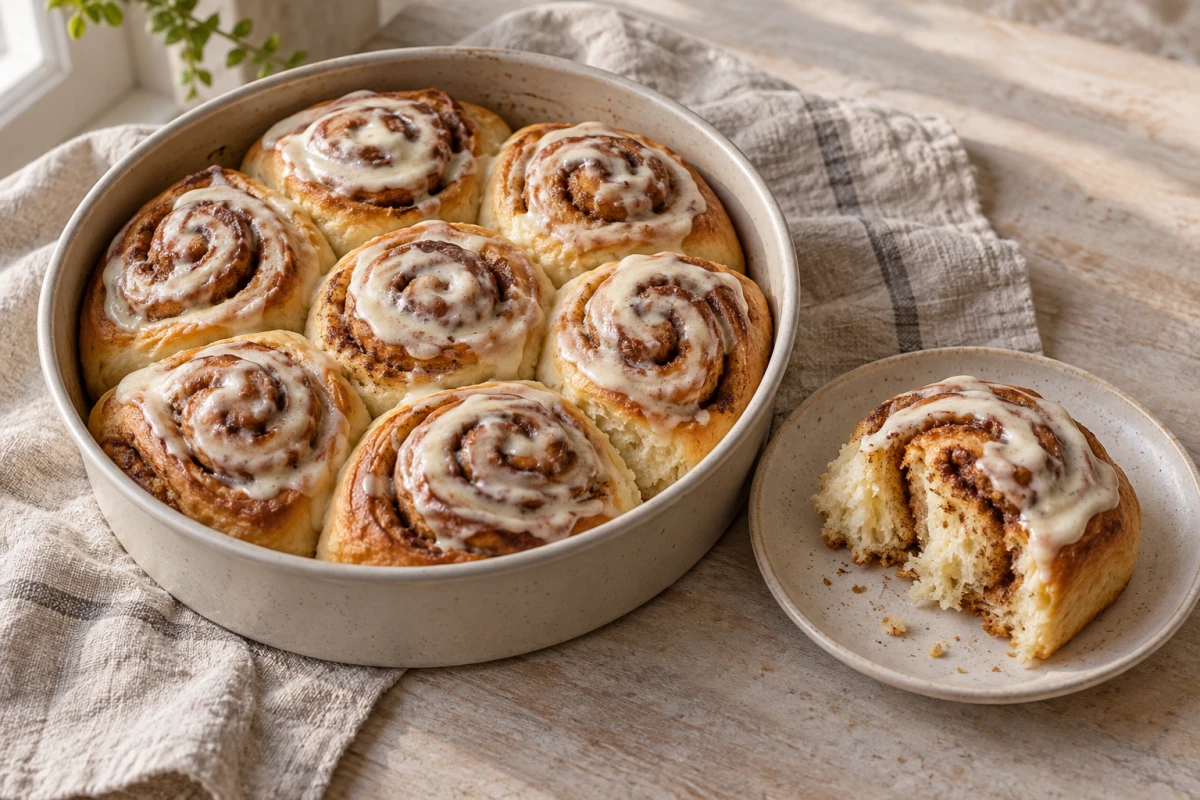
Fluffy Cinnamon Rolls with Cream Cheese Frosting
Soft enriched dough, juicy cinnamon filling, and creamy frosting
These eight cinnamon rolls are made from a soft yeast dough enriched with milk, egg, and butter. Two clearly defined proofing stages create a light crumb, while brown sugar and cinnamon form a moist spiral. A thin layer of cream cheese frosting balances the warm spice with gentle tang.
- Prep time
- 35 minutes
- Cook time
- 25 minutes
- Rest time
- 2 hr 15 min
- Total
- 3 hr 15 min
- Yield
- 8 medium cinnamon rolls (4 servings of 2 rolls)
Ingredients
- 350 g German Type 550 wheat flour or bread flour
- 7 g instant dry yeast
- 180 ml whole milk, warmed to 30–35°C
- 40 g granulated sugar
- 1 medium egg (about 55 g without shell), at room temperature
- 40 g unsalted butter, melted and cooled until lukewarm
- 5 ml vanilla extract
- 5 g fine salt
- 45 g unsalted butter, very soft but not melted
- 60 g light brown sugar
- 8 g ground cinnamon
- 1 g fine salt
- 80 g full-fat cream cheese made from pasteurised milk, cold
- 20 g unsalted butter, softened
- 40 g icing sugar, sifted
- 5 ml freshly squeezed lemon juice
- 2 ml vanilla extract
Instructions
- Line the base and sides of a 24 cm round baking tin with baking parchment. Prepare a draught-free 24–26°C place for proofing. Warm the milk to 30–35°C and use the melted butter only once it has cooled to lukewarm.
- Combine the flour and instant dry yeast in a large bowl. Stir together the milk, granulated sugar, egg, and 5 ml vanilla, add them to the flour mixture, and mix briefly. Work in the 40 g melted butter, then the 5 g salt. Knead the soft dough for 8–10 minutes until smooth, elastic, and only slightly tacky; a gently stretched membrane should transmit light without tearing immediately. Do not work in extra flour.
- Shape the dough into a ball, place it in a clean bowl, and cover tightly. Proof at 24–26°C for 90 minutes. It should be close to doubled, visibly aerated, and a gentle fingertip indentation should spring back only slowly.
- After the first proof, mix the 60 g brown sugar, 8 g cinnamon, and 1 g salt until lump-free. Place the dough on a surface dusted with the bare minimum of flour and press it down gently once to release very large bubbles without kneading it hard.
- Roll the dough evenly into a 36 × 28 cm rectangle. Spread the 45 g very soft butter over it, leaving a 1.5 cm border along the long edge furthest away from you. Distribute the cinnamon-sugar mixture evenly over the buttered area and press it down lightly.
- Starting with the long edge nearest you, roll the dough evenly and snugly, without crushing it, into a 36 cm log. Seal the bare edge and turn the seam underneath. Mark eight sections of about 4.5 cm each, cut exactly 8 rolls with unflavoured dental floss or a very sharp knife, and arrange them cut-side up in the tin.
- Cover the tin and proof at 24–26°C for 30 minutes, until the rolls are visibly puffy and just touching. During the final 20 minutes, preheat the oven to 180°C conventional or 160°C fan and position a rack in the middle.
- Bake for 22–25 minutes. The rolls are done when evenly golden, the center roll has no wet or raw dough spiral, and the thickest section of dough registers 90–93°C. If the surface is already browning strongly after about 18 minutes, tent the tin loosely with foil.
- Remove the tin from the oven and cool the rolls in it for exactly 15 minutes. Then stir the 20 g softened butter with the sifted icing sugar and 2 ml vanilla until smooth; add the cold cream cheese and lemon juice and mix only briefly until homogeneous. Do not beat for an extended time or the frosting may become loose.
- Spread a thin layer of frosting over the rolls while they are still slightly warm, not hot, keeping the spirals visible. Divide into four servings of two rolls each and serve; additional sides and drinks are excluded from the nutrition calculation.
Tips
- The milk and melted butter should be only lukewarm: temperatures above 40°C can damage yeast, while very cold ingredients extend the stated proofing times.
- The fully kneaded dough should remain soft and slightly tacky. Use lightly oiled or damp hands instead of kneading in extra flour, which would dry out the crumb.
- An evenly thick rectangle and a 36 cm log produce eight similar rolls; mark the log in half first, then divide each half into quarters before cutting.
- Dental floss compresses the spirals less than a blunt knife. Use only unflavoured, unwaxed floss and cross the ends over the top of the log to cut.
- Apply the frosting only after the 15-minute cooling period. It runs into the tin on piping-hot rolls but bonds less pleasantly to rolls that are completely cold.
Common mistakes
- Adding overly hot milk or butter to the yeast → cool them to 30–35°C and lukewarm respectively.
- Stiffening the tacky dough with more flour → knead for 8–10 minutes and judge elasticity rather than seeking a dry surface.
- Relying only on the clock → proof at 24–26°C and use near-doubling or visibly puffy rolls as the decisive indicators.
- Using melted butter for the filling → spread very soft but still stable butter so the sugar and cinnamon do not run out of the log.
- Cutting or frosting too early → cool in the tin for 15 minutes so the crumb sets and the frosting remains creamy rather than turning runny.
Variations and substitutions
- Fresh yeast: replace the 7 g instant dry yeast with 21 g fresh yeast, dissolve it in the 30–35°C milk, and follow the same visual proofing cues.
- German Type 405 or lower-protein plain flour: substitute 1:1, but begin with only 170 ml milk and add the final 10 ml only if the dough is not soft enough after 3 minutes of kneading.
- Lactose-free: replace the milk, butter, and cream cheese 1:1 with full-fat lactose-free equivalents; milk remains a declarable allergen.
- Without frosting: omit the cream cheese, 20 g frosting butter, 40 g icing sugar, lemon juice, and 2 ml vanilla; optionally dust the fully cooled rolls with 15 g additional icing sugar. Nutrition will change.
- Cardamom-cinnamon: add 1 g ground cardamom to the cinnamon filling; quantities, proofing times, and baking time remain unchanged.
Storage and notes
Storage
Do not leave cinnamon rolls topped with cream cheese frosting unrefrigerated for more than 2 hours; then store airtight at no more than 5°C for up to 2 days. For the best texture, take them from the refrigerator 20–30 minutes before eating and avoid repeated cycles between room and refrigerator temperature. To reheat, remove the frosting where practical and heat individual rolls thoroughly at 150°C for 5–7 minutes; eat reheated leftovers immediately and do not store them again. Unfrosted, fully cooled rolls may be wrapped individually, frozen airtight for up to 2 months, thawed overnight in the refrigerator, reheated as directed, and frosted only afterward.
Allergens
Contains wheat/gluten, egg, and milk. Depending on the manufacturer, instant yeast, vanilla extract, spices, and icing sugar may carry precautionary allergen statements or processing aids; check labels. The “nut-free” claim applies only when all ingredients are suitably labelled and the preparation area is free from nut cross-contact. Lactose-free dairy products do not remove milk protein or the milk allergen declaration.
Food safety
- Raw flour and raw egg can carry harmful germs: do not taste the dough, minimise airborne flour dust, and thoroughly clean hands, bowls, equipment, and work surfaces after contact.
- Do not use eggs with cracked shells. Choose pasteurised cream cheese and milk and keep them refrigerated until needed.
- Bake the center roll completely: no wet or raw dough spiral should remain, and the thickest section should reach 90–93°C. Insert the thermometer from the side toward the center without touching the base of the tin.
- Because of the cream cheese frosting, chill finished rolls to no more than 5°C within 2 hours; when the ambient temperature exceeds 32°C, the limit is 1 hour.
Editorial context
This presentation and its supporting notes were edited for Rezepte daheim. It does not claim invention of the dish.
No personal kitchen test is currently documented for this version.