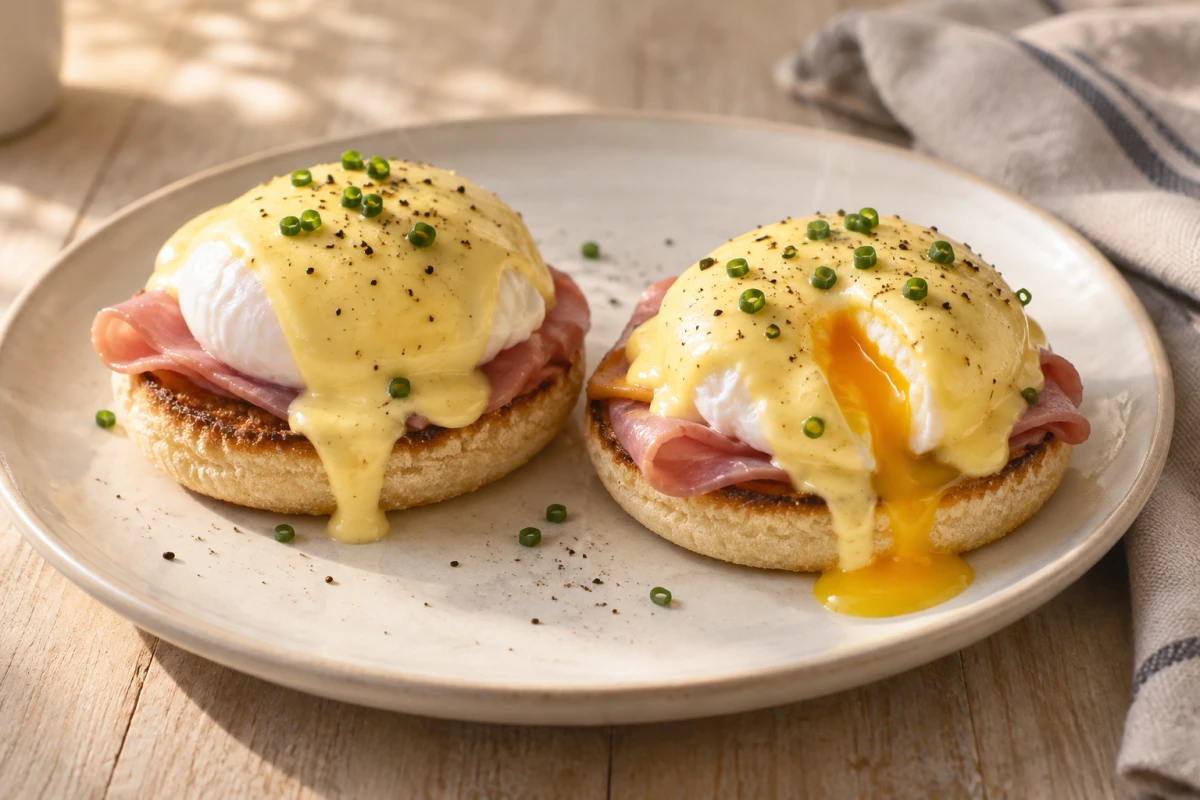
Eggs Benedict with Ham and Hollandaise
Poached eggs on toasted muffins with silky lemon hollandaise
Crisp toasted English muffins, warm cooked ham, and softly poached eggs are topped with freshly whisked lemon hollandaise. Pasteurized egg yolks, controlled bain-marie heat, and a clear workflow make this brunch classic reliable for four people.
- Prep time
- 20 minutes
- Cook time
- 30 minutes
- Total
- 50 minutes
- Yield
- 8 topped muffin halves, 2 Eggs Benedict per brunch serving
Ingredients
- 140 g ungesalzene Butter
- 80 g pasteurisiertes Eigelb, etwa 4 Eigelb
- 20 ml frisch gepresster Zitronensaft
- 15 ml kaltes Wasser
- 2 g feines Salz für die Hollandaise
- 0,2 g Cayennepfeffer
- 4 English Muffins, zusammen etwa 280 g, waagerecht halbiert
- 20 g ungesalzene Butter zum Rösten
- 240 g hochwertiger Kochschinken, 8 dünne Scheiben
- 8 sehr frische Eier, Größe M; für Schwangere, kleine Kinder, ältere oder immungeschwächte Personen pasteurisierte Schaleneier verwenden und vollständig garen
- 30 ml milder Weißweinessig für das Pochierwasser
- 3 l Wasser zum Pochieren
- 4 g feines Salz für das Pochierwasser
- 10 g frischer Schnittlauch, fein geschnitten
- 1 g schwarzer Pfeffer, frisch gemahlen
Instructions
- For the hollandaise, melt the butter completely over low heat without browning it. Remove from the heat and keep liquid at about 55–60°C. Bring 2–3 cm water to heat in a saucepan; it should only steam gently, never boil vigorously.
- Whisk the pasteurized yolks, lemon juice, 15 ml cold water, and 2 g salt in a heatproof bowl. Set the bowl over the bain-marie without letting its base touch the water. Whisk continuously for 3–5 minutes until pale, thick and foamy, and 63–65°C; do not exceed 68°C.
- Remove the bowl from the bain-marie. Whisk in the warm butter drop by drop at first, then in a thin stream, until the sauce is smooth and flows thickly. Stir in the cayenne. Hold the hollandaise over water no warmer than 55°C, keeping the sauce at 45–55°C for no more than 20 minutes; whisk in 5–10 ml warm water if needed. Do not reheat aggressively.
- Split the English muffins and spread the cut sides thinly with the 20 g butter. Toast in a large frying pan over medium heat for 3–4 minutes until golden. Divide among four warmed plates. Warm the ham in the same pan for 30 seconds per side and place one slice on each muffin half.
- For the eggs, heat 3 l water in a wide saucepan to 85–90°C: small bubbles should rise from the bottom, but the water must not boil. Add the vinegar and 4 g salt. Crack each egg individually into a small cup; discard any cracked or unusually smelling egg.
- Poach no more than four eggs at a time. Hold the cup close to the water, gently slide in the egg, and cook for 3–4 minutes. Keep the water only gently moving and do not create a vigorous whirlpool. The white must be completely opaque and set; the yolk remains soft in the classic version.
- Lift the eggs with a slotted spoon, gently blot the underside on clean paper towels, and immediately place them on the ham-topped muffins. Repeat with the remaining eggs; to keep all servings warm, the first four eggs may be held for no more than 5 minutes in 55–60°C water after 3 minutes of poaching.
- Whisk the hollandaise smooth again and check its temperature and consistency. Spoon one quarter of the sauce evenly over the two eggs in each serving. It should coat the tops while leaving some muffin edge and ham visible.
- Sprinkle with chives and black pepper and serve immediately. For people at increased food-safety risk, continue poaching until the yolks are firm and reach at least 74°C; the classic soft-yolk texture will be lost. Do not add unlisted sides.
Tips
- Use only pasteurized yolks for the hollandaise and never let the bowl sit directly in the water; controlled gentle heat prevents scrambling.
- Add the butter drop by drop at first. Once a stable emulsion forms, it can be poured in a thin continuous stream.
- Crack eggs individually into cups and poach no more than four at once so temperature and shape remain manageable.
- Keep the poaching water at a gentle tremble. A rolling boil tears the whites and makes their edges rubbery.
- Prepare the plates, muffins, and ham before poaching; Eggs Benedict cool quickly and must be served immediately after saucing.
Common mistakes
- Hollandaise über kochendem Wasser schlagen → nur dampfendes Wasser verwenden, Schüsselboden ohne Wasserkontakt und Eigelb maximal auf 63–65 °C bringen.
- Butter zu schnell zufügen → anfangs tropfenweise emulgieren; bei Trennung 10 ml warmes Wasser in einer sauberen Schüssel aufschlagen und die getrennte Sauce langsam einarbeiten.
- Hollandaise länger als 20 Minuten warmhalten → frisch im Ablauf einplanen, bei 45–55 °C halten und Reste entsorgen.
- Alte Eier oder sprudelndes Wasser verwenden → sehr frische Eier einzeln prüfen und bei 85–90 °C pochieren.
- Eier nach dem Pochieren nass auflegen → Unterseite kurz abtupfen, damit Muffins knusprig bleiben.
- Acht Eier gleichzeitig garen → in zwei Durchgängen zu je vier arbeiten und den ersten Durchgang nur kurz in warmem Wasser halten.
Variations and substitutions
- Kochschinken: durch 240 g gegarten Truthahnschinken ersetzen; Produktallergene und Nährwerte prüfen.
- English Muffins: durch vier weiche, ungesüßte Weizenbrötchen von je etwa 70 g ersetzen, halbieren und nur die Schnittflächen rösten.
- Schnittlauch: durch 10 g fein geschnittene grüne Frühlingszwiebelteile ersetzen.
- Zitronensaft: durch 15 ml Weißweinessig plus 5 ml Wasser ersetzen; die Hollandaise wird weniger zitrisch.
- Laktosefrei: Butter durch dieselbe Menge laktosefreie Butter ersetzen; Milch bleibt als Allergen kennzeichnungspflichtig.
- Glutenfrei: ausschließlich zertifizierte glutenfreie English Muffins verwenden und Schinkenetikett prüfen; Zubereitung auf kontaminationsfreien Flächen durchführen.
- Eine eifreie oder vegane Variante ist keine 1:1-Substitution, weil Eier und Eigelb Struktur und Identität des Gerichts bestimmen.
Storage and notes
Storage
Eggs Benedict unmittelbar nach dem Anrichten verzehren. Hollandaise wegen Ei und Warmhaltetemperatur nicht länger als 20 Minuten halten und Reste nicht kühlen oder wiederverwenden. Pochierte Eier höchstens 5 Minuten in 55–60 °C warmem Wasser halten; übrig gebliebene weich pochierte Eier entsorgen. Geöffneter Kochschinken kann separat luftdicht bis zum aufgedruckten Verbrauchsdatum, höchstens jedoch 2 Tage, bei maximal 5 °C gelagert werden. Geröstete Muffins frisch servieren. Für Schwangere, kleine Kinder, ältere und immungeschwächte Menschen nur pasteurisierte Eier verwenden und Eigelb vollständig bis mindestens 74 °C garen. Hände und Flächen nach Kontakt mit Schalen reinigen; gesprungene Eier verwerfen.
Allergens
Enthält Ei, Milch und Weizen/Gluten. Kochschinken kann je nach Produkt Sellerie, Senf, Soja, Milch oder weitere deklarationspflichtige Allergene enthalten; Etikett prüfen. Weißweinessig kann Sulfite enthalten. Glutenfreie und laktosefreie Varianten ausschließlich mit entsprechend gekennzeichneten Produkten ausweisen.
Editorial context
This presentation and its supporting notes were edited for Rezepte daheim. It does not claim invention of the dish.
No personal kitchen test is currently documented for this version.